Persecution &
Social Impact
Religious oppression, forced conversions, and the systematic dismantling of Hindu social structures under a regime of terror.
Religious Persecution as Policy
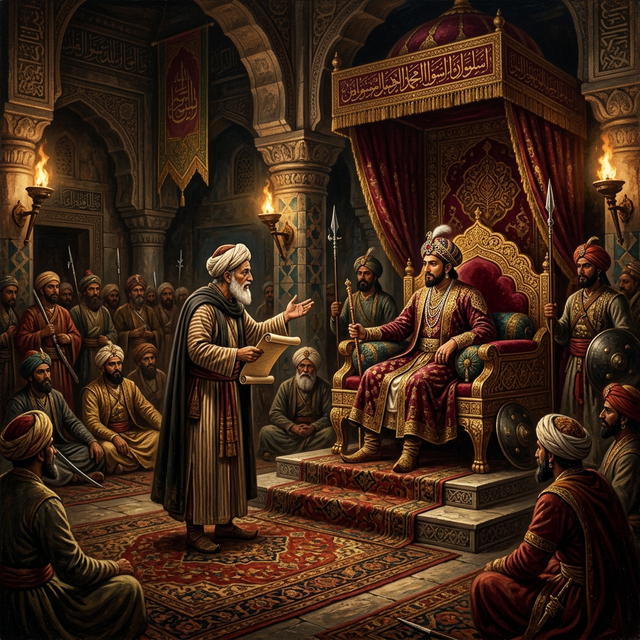
Under Alauddin Khilji, the persecution of Hindus was not incidental or the result of individual military excesses — it was a deliberate, codified policy of the state. The sultan actively sought religious counsel on how to treat his Hindu subjects and implemented recommendations that reduced them to a condition of perpetual subjugation. The chronicler Ziauddin Barani, writing in his Tarikh-i-Firoz Shahi (c. 1357), provides the most detailed and candid account of how anti-Hindu policies were conceived and executed at the highest levels of the Delhi Sultanate.[1]
Barani records that Alauddin consulted Qazi Mughisuddin of Bayana on the legal status of Hindus under Islamic governance. The Qazi advised that according to the Hanafi school of jurisprudence, Hindus were to be treated as zimmis (protected subjects) only on the condition that they paid the jizya with utmost humility. The Qazi further stated that Hindus should be made to feel their subordinate status at every point of interaction with the Muslim ruling class. If they refused to pay or showed defiance, they were to be killed, enslaved, or have their property confiscated.[1]
“I am an unlettered man and do not know what the law of Islam prescribes regarding the Hindus. But this I have discovered—that the Hindus should be made so poor that they are unable to maintain their families with dignity, to think of rebellion, or to conspire against the Sultan. I have therefore given orders that half of the produce of their land should be taken from them.”
— Alauddin Khilji, as recorded by Ziauddin Barani, Tarikh-i-Firoz Shahi (c. 1357)[1]
Alauddin’s own admission — that he was “unlettered” in Islamic law but determined to keep Hindus impoverished and powerless — reveals the crudely utilitarian logic behind his religious persecution. He did not need theological nuance; brute economic and social suppression was sufficient. Barani further notes that Alauddin expressed pride in how thoroughly his revenue collectors broke the spirit of Hindu landowners, ensuring they had no surplus with which to arm themselves or fund resistance.[1]
The Qazi’s recommendations went beyond taxation. He urged the Sultan to enforce the collection of jizya with such severity that Hindus would present themselves at the collector’s door in a state of abject submission. The Qazi lamented that under the previous Sultanate rulers, Hindus had grown too prosperous and bold, riding fine horses, wearing rich garments, and living in comfort — all of which, in his view, violated the proper Islamic order. Alauddin, according to Barani, enthusiastically embraced this vision and set about implementing it with systematic rigor.[1]
The persecution of Hindus under Alauddin Khilji was not a byproduct of warfare but an explicit policy objective. The sultan consulted religious authorities, received formal legal opinions, and implemented a comprehensive program designed to ensure the permanent subjugation of the Hindu population. This is documented by Barani himself, a Muslim chronicler sympathetic to the Sultanate.
Forced Conversions
Forced conversion to Islam was a recurring feature of Alauddin Khilji’s military campaigns and administrative policies. While the scale of conversions during his reign is difficult to quantify precisely, multiple primary sources document the practice as widespread, systematic, and often the only alternative offered to conquered populations facing death or enslavement.[2]
During the siege and sack of major fortresses, captured soldiers and civilians were routinely given the choice between conversion and death. At Gujarat in 1299 CE, Alauddin’s generals — Ulugh Khan and Nusrat Khan — conducted a campaign of extraordinary brutality. Thousands of Hindus were slain and vast numbers were enslaved. Among the captives was the Hindu slave boy Kafur (later known as Malik Kafur), who was forcibly converted and would go on to become Alauddin’s most feared military commander. Kafur’s own story embodies the violence of forced conversion: a young Hindu captured in a raid, converted under duress, and transformed into an instrument of further conquest against his own people.[1]
The fall of Ranthambore in 1301 CE and Chittor in 1303 CE both resulted in mass conversions. After the capitulation of Ranthambore, the surviving defenders who did not perish in battle or self-immolation were offered conversion as a condition of survival. Barani records that many Hindu warriors and their families accepted Islam under these circumstances, though the chronicles frame this as voluntary submission rather than the coercion it plainly was.[1]
“Whenever a fort was conquered, the idols were broken and the mosques were established. Those who did not accept the faith were put to the sword.”
— Ziauddin Barani, Tarikh-i-Firoz Shahi[1]
The theological justification for forced conversion rested on the doctrine that the expansion of Dar al-Islam (the realm of Islam) was a sacred obligation. Hindu-majority territories were classified as Dar al-Harb (the realm of war), where the application of force to bring populations under Islamic rule was considered religiously meritorious. Court theologians and chroniclers like Amir Khusrau celebrated the conversion of Hindus as a triumph of faith, often describing the destruction of temples and the establishment of mosques in the same breath as the conversion of populations.[3]
In the conquered territories of the Deccan and South India, Malik Kafur’s campaigns between 1306 and 1311 CE produced enormous numbers of forced conversions. The populations of defeated kingdoms — the Yadavas of Devagiri, the Kakatiyas of Warangal, the Hoysalas of Dwarasamudra, and the Pandyas of Madurai — faced systematic pressure to convert. Enslaved populations, in particular, had no practical means of resisting conversion, as Islamic law provided certain protections to Muslim slaves that were denied to non-Muslim captives.[2]
The pattern was consistent across campaigns: after a military victory, temples were demolished, mosques erected in their place, and the surviving population was given the choice of conversion, payment of punitive taxes under humiliating conditions, or execution. The chroniclers of the period, writing from within the Islamic court, saw nothing objectionable in this process and often celebrated it as divinely sanctioned.
Impact on Women
The impact of Alauddin Khilji’s campaigns on women represents one of the most harrowing chapters in Indian history. Across Rajputana and beyond, women faced the unbearable choice between capture — which meant enslavement, forced conversion, and incorporation into the harems of Muslim rulers — and death by their own hands. The practice of jauhar (mass self-immolation), in which Rajput women collectively entered flames rather than submit to capture, became tragically widespread during this period.[4]
The most devastating instance occurred at Chittor in 1303 CE. When it became clear that the fortress would fall, Rani Padmini (also known as Padmavati) and thousands of Rajput women performed jauhar, immolating themselves on a massive funeral pyre rather than face capture by Alauddin’s army. Contemporary and near-contemporary accounts describe the horror of this event: the flames consumed women of every age, from elderly matriarchs to young girls, while the men sallied forth in a final, suicidal charge (saka) against the besieging forces. Estimates of the number of women who perished in the Chittor jauhar vary, but most historians place the figure in the thousands.[4]
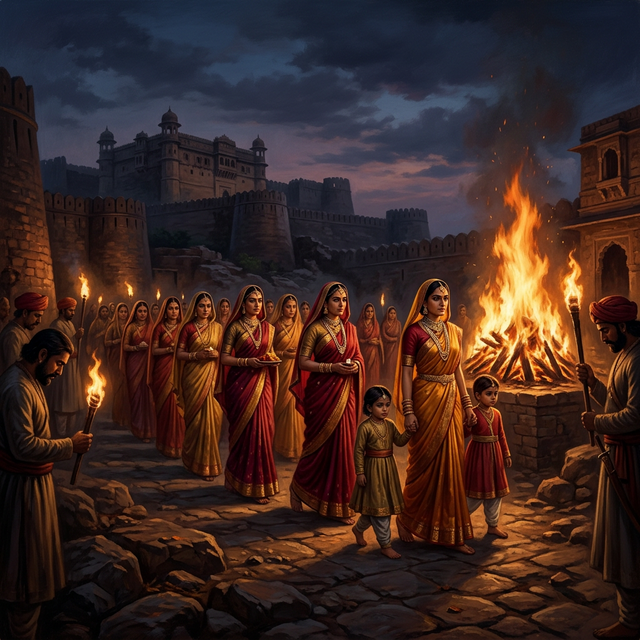
A similar tragedy unfolded at Ranthambore in 1301 CE, where the women of Hammiradeva’s court performed jauhar before the fortress fell. The chronicler Nayachandra Suri, writing in the Hammiramahakavya, describes the scene with restrained grief: women adorned themselves as though for a festival before walking into the flames, preferring the certainty of death to the uncertainty of what awaited them at the hands of the conquerors.[5]
Alauddin’s personal conduct toward women further illustrates the character of his rule. He maintained an enormous harem populated in significant part by women captured during his military campaigns. The capture of Kamala Devi, the wife of the defeated Gujarat ruler Karna Vaghela, in 1299 CE and her forced incorporation into Alauddin’s household is documented by multiple chroniclers. Alauddin later also sought Kamala Devi’s daughter, Deval Devi, who was eventually captured and married to Alauddin’s son Khizr Khan. Amir Khusrau wrote the romance Ashiqa about this union, presenting as a love story what was in reality the forced marriage of a captive princess.[3]
The mass self-immolation of Rajput women was not an expression of choice but a desperate response to an impossible situation. That thousands of women chose death over the fate they knew awaited them at the hands of Alauddin’s forces speaks to the terror his campaigns inflicted. The practice of jauhar, while sometimes romanticized in later literature, was fundamentally a tragedy born of conquest and the threat of sexual violence and enslavement.
Beyond the dramatic instances of jauhar, ordinary women across the territories ravaged by Alauddin’s campaigns suffered enormously. Raids on towns and villages routinely resulted in the abduction of women, who were enslaved and distributed as spoils of war. Barani notes that slave markets in Delhi were flooded with captured women, and that the price of enslaved people fell drastically during Alauddin’s reign due to the sheer volume of captives taken during his relentless campaigns.[1]
Malik Kafur’s Campaigns
The career of Malik Kafur is itself a testament to the violence of Alauddin Khilji’s regime. Originally a Hindu, Kafur was captured as a young boy during the sack of Khambhat (Cambay) in Gujarat in 1299 CE. He was reportedly purchased by the general Nusrat Khan for a thousand dinars, earning him the epithet Hazar-Dinari (the one worth a thousand dinars). Forcibly converted to Islam and made a eunuch slave of the court, Kafur rose through the ranks with extraordinary speed, eventually becoming Alauddin’s most trusted general and, in his final years, the effective ruler of the Sultanate.[1]
Between 1306 and 1311 CE, Malik Kafur led a series of devastating campaigns into the Deccan and South India that rank among the most destructive military expeditions in Indian history. These campaigns systematically dismantled four major kingdoms and resulted in plunder of a scale rarely seen in the medieval world.[3]
1306–1307 CE: Campaign against the Yadavas of Devagiri. Raja Ramachandra was defeated and forced to pay an enormous tribute, including 600 maunds of pearls, gold, and silver.
1309–1310 CE: Campaign against the Kakatiyas of Warangal. Prataparudra was forced to surrender, yielding the legendary Koh-i-Noor diamond (according to some accounts) along with vast quantities of treasure.
1310–1311 CE: Campaign against the Hoysalas of Dwarasamudra and the Pandyas of Madurai. The great temple city of Madurai was sacked, and Hindu and Jain temples across the region were systematically destroyed and plundered.
Amir Khusrau, who accompanied Kafur on several of these campaigns, provides vivid descriptions of the destruction in his works Khazain-ul-Futuh and Miftah-ul-Futuh. He describes with undisguised triumph the demolition of temples, the seizure of idol-treasures, and the subjugation of Hindu kings. At Devagiri, the Yadava treasury was stripped bare. At Warangal, the Kakatiya fortifications — considered among the strongest in India — were overcome, and the wealth accumulated over centuries was carted back to Delhi.[3]
The sack of Madurai in 1311 CE was particularly destructive. Kafur’s forces plundered the Meenakshi Temple complex and destroyed numerous other sacred sites across the Pandya kingdom. The loot from this single campaign was so enormous that Barani describes the treasure train returning to Delhi as stretching for miles: elephants loaded with gold, camels carrying precious stones, carts heaped with silver, and vast columns of enslaved people. The historian K.S. Lal estimates that the total plunder brought back from the southern campaigns amounted to over 241 tonnes of gold and 20,000 horses, along with countless precious stones and enslaved captives.[2]
“The temple of Dwarasamudra was razed to the ground, and the golden idol that had been worshipped for centuries was broken to pieces. The fragments of gold were melted down, and the treasure was loaded onto elephants for the march back to Delhi.”
— Amir Khusrau, Khazain-ul-Futuh (c. 1311)[3]
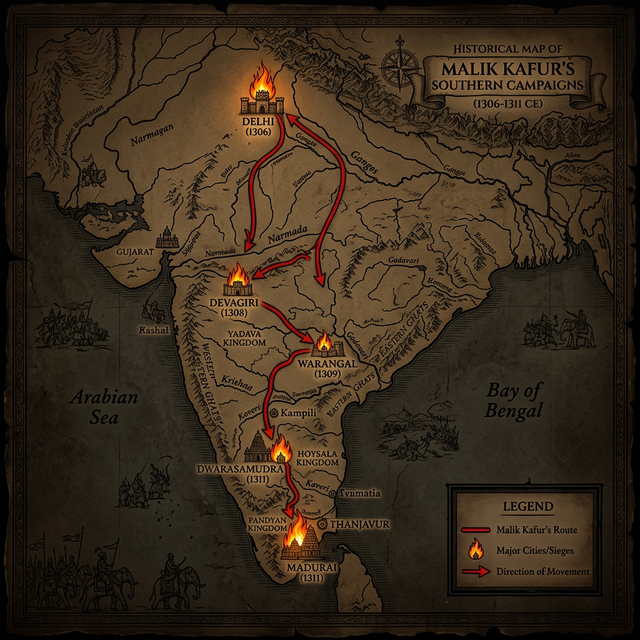
The irony of Kafur’s career was not lost on later historians. A Hindu child, torn from his community, forcibly converted, and transformed into one of the most effective instruments of destruction ever wielded against Hindu civilization. His campaigns obliterated centuries of cultural, artistic, and religious achievement across South India, and the wealth he extracted enriched the Delhi Sultanate while impoverishing the conquered territories for generations.[2]
Restrictions on Hindu Life
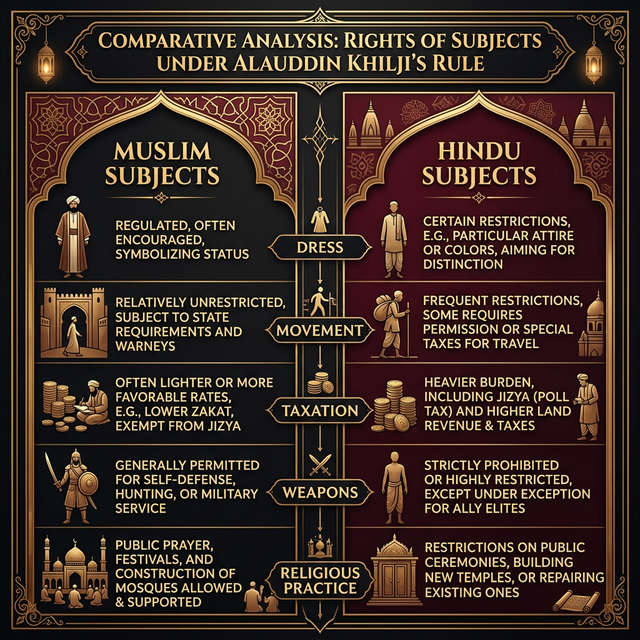
Beyond the violence of military campaigns and the trauma of forced conversions, Alauddin Khilji imposed a comprehensive system of social restrictions on the Hindu population that amounted to an apartheid-like regime. These regulations, documented in detail by Barani, were designed to strip Hindus of dignity, autonomy, and the capacity for resistance. They touched every aspect of daily life, from dress and transportation to social gatherings and household possessions.[1]
Prohibition on riding horses: Hindus were forbidden from riding horses, a restriction that effectively barred them from military service, rapid travel, and any activity associated with social prestige. Only Muslims were permitted to maintain and ride horses.
Ban on possessing weapons: Hindus were prohibited from owning or carrying weapons of any kind, including swords, bows, and even knives beyond what was strictly necessary for household use. This ensured that any attempt at armed resistance was impossible.
Dress codes: Hindus were required to wear clothing that distinguished them visibly from Muslims. They were forbidden from wearing fine garments, silk, or any attire that might suggest prosperity or equality with the ruling class.
Prohibition on social gatherings: Hindus were banned from assembling in groups, whether for festivals, religious ceremonies, or even family celebrations. The intent was to prevent any form of collective organization that could serve as a basis for conspiracy or rebellion.
Surveillance of households: Alauddin established an extensive intelligence network that monitored Hindu households. Barani records that the Sultan’s spies reported on the private activities of Hindu landowners, merchants, and community leaders, ensuring that no one accumulated wealth, influence, or weapons in secret.
Confiscation of surplus wealth: Any Hindu found to possess wealth beyond bare subsistence was subject to confiscation. The tax burden — 50% of produce, plus jizya, grazing tax, and house tax — was calibrated to leave Hindu families with barely enough to survive.
Barani records Alauddin’s satisfaction with the effects of these policies. The chronicler notes that Hindu women were reduced to working as servants in Muslim households to supplement their families’ meagre incomes. Hindu landowners who had previously maintained a dignified existence were rendered destitute. The prohibition on horses meant that Hindus could not travel quickly enough to organize across regions, while the ban on weapons ensured they posed no military threat.[1]
“The Hindu was to be left unable to possess a horse, to wear fine clothes, to carry arms, or to possess any luxury whatsoever. He was to work for the Muslim and to live at the lowest level.”
— Ziauddin Barani, Tarikh-i-Firoz Shahi, on the Sultanate’s policy toward Hindus[1]
The cumulative effect of these restrictions was the creation of a two-tiered society in which Hindus were systematically reduced to second-class status. They could not worship freely, assemble publicly, travel with dignity, defend themselves, or accumulate the resources needed to maintain their cultural and religious institutions. Every avenue of social mobility, political participation, and cultural expression was methodically sealed off. The system bore striking parallels to the most oppressive apartheid regimes of later centuries — with the critical difference that it was imposed in the name of religious supremacy.[2]
Destruction of Social Fabric
The combined weight of economic exploitation, religious persecution, and social restrictions tore apart the traditional structures of Hindu community life. For centuries before the Delhi Sultanate, Hindu society had been organized around interlocking systems of royal patronage, temple-based community networks, guild-organized artisan economies, and the rhythms of religious festivals and pilgrimages. Alauddin’s policies attacked every one of these pillars simultaneously, producing a rupture in the social fabric that would take centuries to repair — and in many respects, never fully healed.[2]
Loss of royal patronage: The destruction or subordination of Hindu kings eliminated the primary source of funding for temples, monasteries, centres of learning, and artistic production. Royal courts had sustained poets, musicians, scholars, and artisans for generations. When the Rajput, Yadava, Kakatiya, Hoysala, and Pandya courts fell, these patronage networks collapsed overnight. Thousands of artists, musicians, dancers, scholars, and religious practitioners lost their livelihoods and the institutional frameworks that had sustained their traditions.[6]
Disruption of temple economies: Hindu temples were not merely places of worship; they functioned as economic hubs, community centres, educational institutions, and repositories of wealth. Temples employed priests, musicians, dancers, sculptors, cleaners, cooks, and administrators. They operated charitable kitchens, hospitals, and schools. They held agricultural land and managed irrigation systems. When Alauddin’s forces destroyed or desecrated temples and confiscated their endowments (devadana lands), they dismantled not just religious institutions but the entire economic and social ecosystem that depended on them.[6]
Collapse of artisan traditions: The artisan guilds (shrenis) that had produced India’s legendary sculptures, bronzes, textiles, and architectural wonders depended on continuous patronage from temples and royal courts. With both sources of patronage eliminated, entire craft traditions were extinguished within a generation. The skills needed to create the intricate stone carvings of the Hoysala period or the bronze sculptures of the Chola tradition could not survive without practitioners, and practitioners could not survive without patrons. What was lost was not just individual works of art but entire systems of knowledge transmission that had evolved over millennia.[2]
The economic, religious, and social policies of Alauddin Khilji were not independent measures — they reinforced one another to create a comprehensive system of suppression. Economic impoverishment prevented Hindus from funding temples and schools. Temple destruction eliminated community gathering places and patronage centres. Social restrictions prevented the formation of alternative networks. The ban on gatherings prevented collective mourning, resistance, or cultural preservation. Each policy magnified the destructive effect of the others.
Dissolution of community bonds: The ban on Hindu social gatherings struck at the heart of community cohesion. Festivals like Diwali, Holi, and Navaratri were not merely religious observances but the social glue that held communities together across caste, class, and regional lines. Pilgrimages connected people across vast distances and reinforced a shared cultural identity. By banning these gatherings, Alauddin atomized Hindu society, reducing it to isolated households that could neither organize resistance nor maintain the collective cultural memory that sustained their traditions.[1]
Destruction of educational systems: Hindu and Jain centres of learning — pathashalas, agraharas, and monastic universities — depended on land grants and endowments for their survival. When these were confiscated, the institutions collapsed. The scholars who staffed them were scattered, and the manuscripts they maintained were destroyed or dispersed. Entire lineages of philosophical, scientific, and literary knowledge were broken. The impact on India’s intellectual heritage was incalculable.[6]
Contemporary Accounts
The most detailed contemporary accounts of Alauddin Khilji’s persecution policies come from two principal sources within the Sultanate’s own court: Ziauddin Barani and Amir Khusrau. Their writings provide an invaluable, if deeply troubling, window into how the regime perceived and justified its treatment of the Hindu population.[1]
Ziauddin Barani (1285–1357) was a political historian and the most important chronicler of the Delhi Sultanate during the 14th century. His Tarikh-i-Firoz Shahi, written around 1357 CE during the reign of Firoz Shah Tughlaq, covers the reigns of several sultans, with extensive sections on Alauddin Khilji. Barani was a deeply orthodox Muslim who believed in the strict application of Islamic law to governance, and his account of Alauddin’s anti-Hindu policies is characterized by frank approval. He records Alauddin’s conversations with the Qazi of Bayana, the rationale for economic restrictions, and the effects of these policies on the Hindu population with a candour that modern readers find both illuminating and disturbing.[1]
Barani does not attempt to conceal the cruelty of Alauddin’s policies. He records the sultan’s own words about impoverishing Hindus, describes the surveillance apparatus that monitored their households, and notes the effects of the tax regime with clinical precision. Yet his tone is not one of condemnation but of admiration — he presents Alauddin as a ruler who, despite being unlettered in Islamic jurisprudence, intuitively grasped how to keep the Hindu population in its proper place. For Barani, the subjugation of Hindus was a feature of good governance, not a moral failing.[1]
“The Sultan demanded from the Hindus, the payment of tribute and taxes with such rigour that the chowdhries, khots, and muqaddams were not able to ride on horseback, to find arms, to wear fine clothes, or to enjoy any luxury. The Hindu was to be left unable to keep even enough for the bare sustenance of himself and his family.”
— Ziauddin Barani, Tarikh-i-Firoz Shahi[1]
Amir Khusrau (1253–1325) was a Sufi poet and scholar who served in the courts of multiple Delhi sultans, including Alauddin Khilji. His works — Khazain-ul-Futuh (The Treasures of Victory), Miftah-ul-Futuh (The Key to Victories), and Ashiqa — provide detailed accounts of Alauddin’s military campaigns and their aftermath. Khusrau accompanied Malik Kafur on his southern campaigns and wrote vivid descriptions of the sack of temples, the capture of cities, and the subjugation of Hindu kingdoms.[3]
Khusrau’s writing is celebratory in tone, framing the destruction of Hindu temples and the conversion of populations as glorious achievements. He describes the demolition of idols with evident satisfaction and the establishment of mosques on temple sites as the triumph of truth over falsehood. Yet within his triumphal narrative, the details he provides inadvertently reveal the scale of suffering inflicted on the conquered peoples: the mountains of plunder, the columns of enslaved captives, the systematic destruction of sacred sites, and the dismantling of centuries-old civilizations.[3]
The value of Barani and Khusrau as historical sources lies precisely in their biases. Because they wrote from within the Sultanate’s court and approved of its policies, they had no reason to exaggerate the suffering of Hindus — if anything, they understated it. When Barani calmly records that Hindus were reduced to poverty by design, or when Khusrau celebrates the demolition of temples with literary flourish, they are confirming the reality of these events from the perspective of the perpetrators. Their accounts are not accusations; they are confessions.
Hindu and Jain sources from this period are far fewer in number, largely because the very institutions that would have produced and preserved such accounts — temples, monasteries, and royal courts — were the ones being systematically destroyed. The Kanhadade Prabandha by Padmanabha (c. 15th century) and the Hammiramahakavya by Nayachandra Suri (c. 1400) provide Rajput perspectives on the resistance to Alauddin’s invasions, including accounts of jauhar, battlefield heroism, and the devastation of Hindu communities. These texts, written from the perspective of the vanquished, offer a counterpoint to the triumphalism of the Sultanate chronicles and underscore the human cost that the Muslim court writers either ignored or celebrated.[4][5]