The Lasting
Damage
Quantifying seven centuries of cultural discontinuity — heritage sites lost forever, artistic traditions broken, and a civilization scarred beyond repair.
Quantifying the Destruction
The numbers alone are staggering. Each figure below represents not merely a statistic but an irreplaceable fragment of one of the world's oldest continuous civilizations — reduced to rubble and ash in the span of two decades.
Heritage Sites Lost Forever
Temples that stood for centuries, embodying the spiritual and artistic genius of Indian civilization, were reduced to ruins from which they never recovered.
The Somnath Cycle
Perhaps no site better illustrates the repeated trauma inflicted upon Indian sacred heritage than the Somnath temple in Gujarat. Though its most famous destruction came at the hands of Mahmud of Ghazni in 1026 CE, the temple was rebuilt and subsequently targeted again during the Khilji era. When Alauddin Khilji's general Ulugh Khan invaded Gujarat in 1299 CE, the recently reconstructed Somnath temple was once again desecrated and plundered.[2] This cycle of destruction and rebuilding — only to face destruction again — became a defining pattern of Indian civilization's struggle for cultural survival.
Lost Temple Complexes of Gujarat
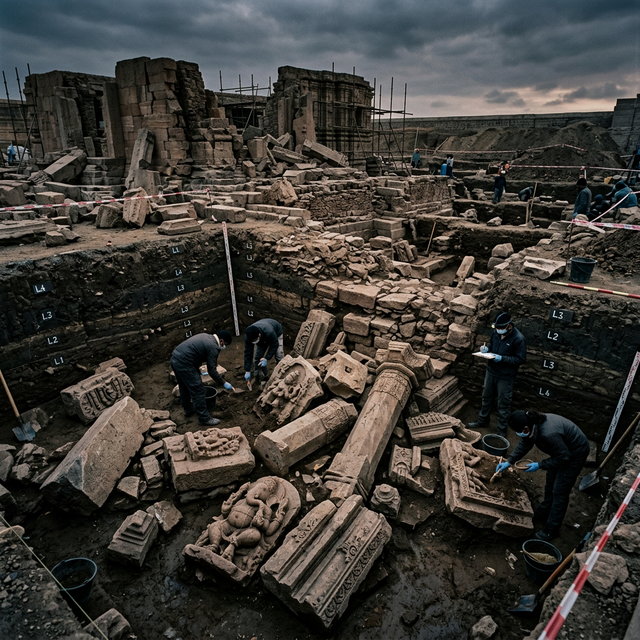
The 1299 CE invasion of Gujarat under Nusrat Khan and Ulugh Khan was one of the most devastating campaigns of Khilji's reign. The great temple complexes of Anhilwara (modern Patan), the capital of the Gujarat Sultanate, were systematically dismantled. The Rudra Mahalaya at Siddhpur — a colossal Shiva temple complex that had taken decades to construct under the Chaulukya dynasty — was so thoroughly demolished that only scattered columns and fragments survive today.[3] The Archaeological Survey of India's excavations at the site have revealed foundation walls, broken sculptures, and decorative fragments that attest to the grandeur of what once stood there.
The destruction at Anhilwara extended beyond the Rudra Mahalaya. Numerous Jain temples, including the sacred shrines at Girnar, were desecrated. The treasuries of Hindu and Jain temples, which had served as community banks and repositories of centuries of devotional offerings, were emptied entirely. The great Jain temple at Devagiri (Daulatabad) was similarly plundered during the Deccan campaigns.[4]
The Devastation of Rajasthan
Rajputana bore some of the heaviest cultural losses. The siege and sack of Ranthambore (1301 CE), Chittor (1303 CE), and numerous smaller fortified towns resulted in the destruction of temple complexes that had been maintained and embellished for generations. At Chittor, the famous Vijay Stambha (Tower of Victory) and the temples surrounding it were damaged, though some survived in partial form. However, dozens of smaller shrines and religious structures within the fort were obliterated entirely, their very foundations later built over.[5]
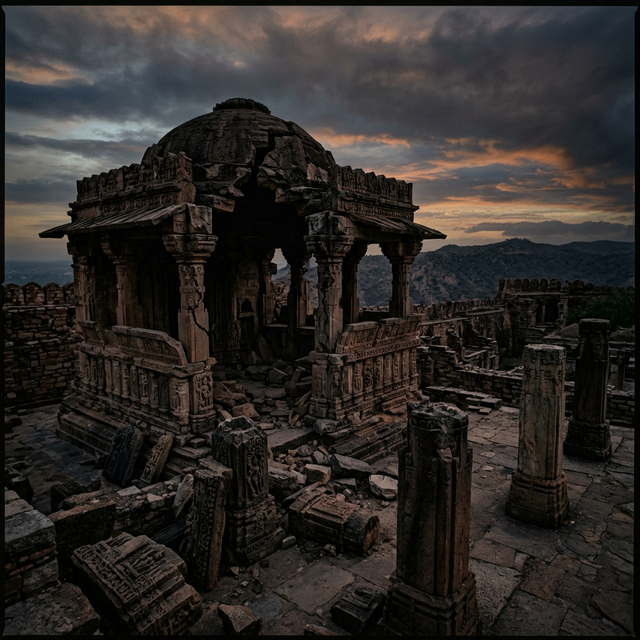
Archaeological surveys at Ranthambore have uncovered fragments of sculptural programs — broken deities, shattered decorative panels, and smashed architectural members — that point to a deliberate and methodical campaign of cultural erasure. These were not the random damages of warfare but the systematic obliteration of religious and cultural symbols.[6]
Malwa and Central India
The campaigns in Malwa brought destruction to some of central India's finest temple complexes. Temples at Dhar, Mandu, and Ujjain — cities that had been centers of Hindu learning and devotion for millennia — were ransacked. The Paramara dynasty's patronage of temple architecture, which had produced masterworks of stone carving over three centuries, came to an abrupt and violent end. Many of the region's temples were not merely damaged but dismantled to their foundations, their carved stone members repurposed as building material for mosques and fortifications.[7]
Broken Artistic Traditions
When temples were destroyed, it was not only stone that was lost. Entire lineages of artistic knowledge — sculptural techniques, architectural systems, iconographic traditions — were severed permanently.
The Disruption of Sculptural Traditions
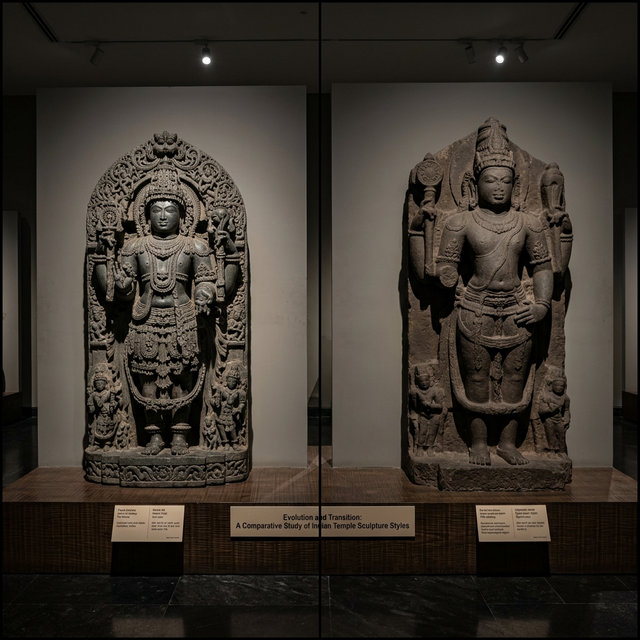
Indian temple sculpture during the 12th and 13th centuries had reached extraordinary levels of sophistication. The Chaulukya-Paramara school of western India, the Chandela sculptural tradition of Bundelkhand, and the Hoysala style of Karnataka represented centuries of accumulated knowledge passed from master to apprentice in unbroken lineages. These were not traditions that could be learned from books; they were embodied skills transmitted through years of hands-on training within the workshop (shilpashala) system.[9]
When Khilji's armies destroyed temples and scattered artisan communities, these chains of transmission were broken. The master sculptors (sthapatis and shilpis) who held this knowledge were killed, enslaved, or forced to flee. Without active temple construction programs to sustain them, the surviving artisans could not practice their craft, and their skills atrophied within a generation. The result is a visible discontinuity in the sculptural record of western and central India.[10]
Temple Architecture Knowledge Lost
The destruction extended far beyond surface decoration. Indian temple architecture followed elaborate systems of sacred geometry and proportional relationships codified in texts such as the Manasara, Mayamatam, and Samarangana Sutradhara. However, the actual application of these principles involved extensive practical knowledge that existed primarily within the oral tradition of hereditary architect-priest families (sthapati lineages). When these families were dispersed or destroyed, the living tradition died even where the texts survived.[11]
The sophisticated structural engineering that allowed the construction of towering shikharas (temple spires), complex corbelled ceilings, and interlocking stone assemblies without mortar — techniques that had been refined over centuries in the Nagara and Vesara architectural schools — was severely diminished after the Khilji era. Temples built in the post-invasion period in regions affected by Khilji's campaigns show a marked decline in structural ambition and technical execution.[12]
The Gap in Indian Art History
Art historians studying Indian sculpture and architecture have long noted a pronounced gap in artistic production during the late 13th and early 14th centuries across northern and western India. This is not merely a gap in surviving works (which might be attributed to the chance of preservation) but a genuine cessation of production. The patronage systems that sustained artistic creation — royal courts, wealthy merchants, and temple trusts — were systematically dismantled by Khilji's economic and religious policies. Without patrons, even surviving artisans had no work.[13]
The traditions of bronze casting, ivory carving, manuscript illumination, and textile production that had flourished under Hindu and Jain patronage were similarly disrupted. Some of these traditions eventually revived in attenuated forms, but others — particularly those associated with specific temple complexes and their associated artisan communities — were lost entirely. The intricate lost-wax bronze casting tradition of certain Gujarat workshops, for instance, never recovered its pre-invasion quality.[14]
Cultural Discontinuities
Khilji's reign did not merely destroy physical structures. It created lasting breaks in the living fabric of Indian civilization — disrupting religious practices, dismantling educational institutions, and erasing historical memory.
Religious Practices Disrupted
The systematic destruction of temples and persecution of Hindu and Jain religious communities disrupted centuries-old patterns of worship, pilgrimage, and ritual practice. Temples were not merely places of prayer in medieval Indian society; they were the organizational centers of community life, serving as schools, hospitals, courts, performance venues, and community gathering spaces. Their destruction fragmented the social fabric at the most fundamental level.[15]
Specific ritual traditions tied to particular temple sites were extinguished when those temples were destroyed. The elaborate festival calendars, processional routes, and communal ceremonies that had organized village and urban life for generations were disrupted beyond recovery. In many cases, the priestly families who maintained the oral traditions of specific temple rituals were scattered or killed, ensuring that even if the physical structure were rebuilt, the living tradition could not be reconstituted.[16]
Educational Institutions Destroyed
The Indian educational system of the pre-Khilji period was centered on temple-affiliated schools (pathshalas), monastery-universities (mathas and viharas), and court-sponsored centers of learning. These institutions taught not only religious texts but also grammar, logic, astronomy, mathematics, medicine, architecture, and the performing arts. The destruction of temples entailed the destruction of their attached educational infrastructure.[17]
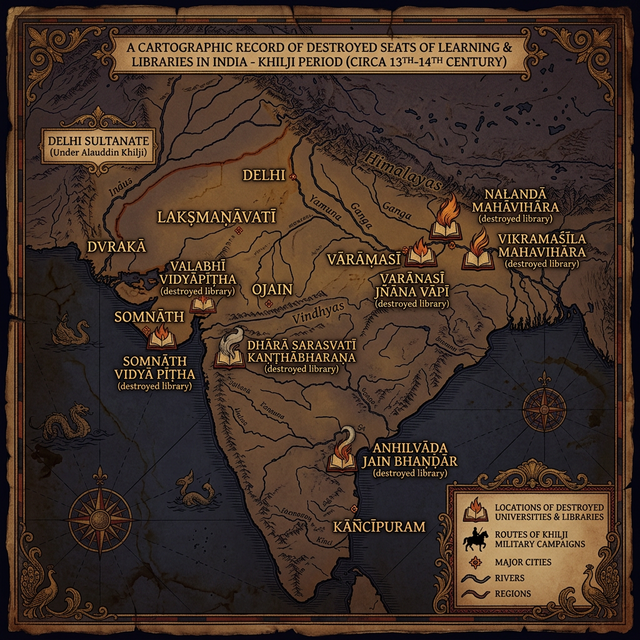
While the great universities of Nalanda and Vikramashila had already been destroyed by Bakhtiyar Khilji in the late 12th century, numerous smaller but significant centers of learning continued to function in western, central, and southern India through the 13th century. Khilji's campaigns extended the zone of educational destruction far beyond what previous invaders had accomplished. The Sanskrit learning centers of Gujarat, the Jain scholarly communities of Rajasthan, and the temple schools of Malwa were all devastated.[18]
Sanskrit Learning Centers Dismantled
Sanskrit was the primary vehicle of scientific, philosophical, and literary culture in pre-invasion India. Its study required years of intensive training under learned teachers (acharyas) who themselves represented unbroken chains of intellectual transmission stretching back centuries. The disruption of these teaching chains during the Khilji era had consequences that extended far beyond language loss — it meant the interruption of entire philosophical, scientific, and literary traditions.[19]
The scholar Sheldon Pollock has documented what he terms the "Sanskrit cosmopolis" — a vast, interconnected cultural sphere sustained by the production and circulation of Sanskrit texts. The Khilji invasions dealt a severe blow to this system in western and central India, disrupting the networks of patronage, institutional support, and scholarly exchange that had sustained Sanskrit literary and intellectual culture. The effects were not immediately total, but they initiated a process of decline that accelerated over subsequent centuries.[20]
The Loss of Historical Records and Manuscripts
Perhaps the most intellectually devastating aspect of Khilji-era destruction was the loss of manuscripts. Indian civilization had produced a vast body of written knowledge — philosophical treatises, scientific texts, literary works, historical chronicles, medical manuals, architectural guides, astronomical tables — preserved on palm leaf, birch bark, and paper in temple libraries, monastic collections, and court archives.[21]
When temples and libraries were burned, these irreplaceable documents were destroyed. Unlike stone sculptures, which survive as fragments even after deliberate destruction, manuscripts are completely obliterated by fire. The extent of this loss can only be guessed at from the references in surviving texts to works that no longer exist. Scholars studying Indian intellectual history regularly encounter citations to treatises, commentaries, and original works that have vanished entirely — ghostly traces of a knowledge tradition that was violently interrupted.[22]
Population Impact
Behind every destroyed temple and burned manuscript were human beings — communities uprooted, families shattered, and entire populations driven from their ancestral lands.
Displacement of Communities
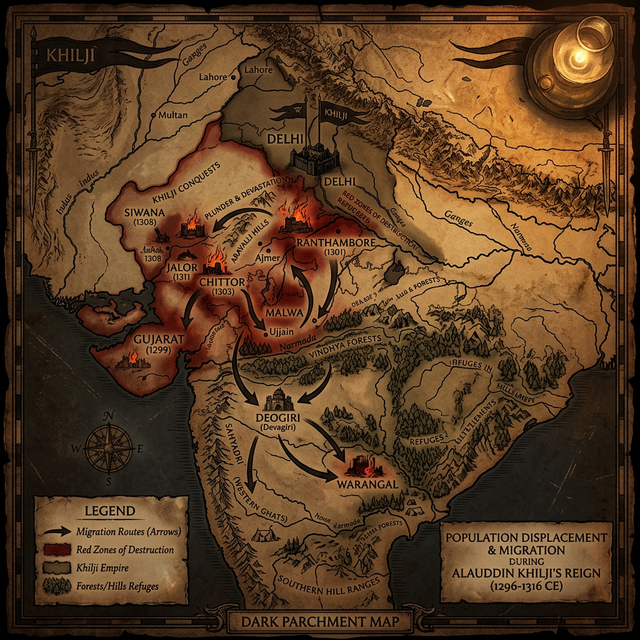
Khilji's military campaigns created massive waves of displacement across the subcontinent. The invasion of Gujarat in 1299 CE alone displaced tens of thousands of people, including entire mercantile communities, Brahmin scholarly families, and artisan guilds. Many fled to the remote forests and hill regions of Rajasthan, to the relatively safer territories of the far south, or to the less accessible parts of the Western Ghats. This forced migration fundamentally altered the demographic landscape of western India.[23]
The Jain community of Gujarat, which had been one of the wealthiest and most culturally productive groups in western India, was particularly hard hit. Jain merchants, scholars, and monks fled in large numbers, some to Rajputana, others further south. The disruption of Jain mercantile networks that had facilitated trade across the Indian Ocean had economic consequences that extended far beyond Gujarat itself.[24]
Demographic Changes
The combined effects of warfare, famine (exacerbated by Khilji's extractive taxation policies), enslavement, and displacement caused significant demographic shifts in the affected regions. The population of cities like Anhilwara and Devagiri, which had been thriving urban centers, declined dramatically. Rural areas were similarly depopulated as farmers fled the crushing burden of the 50% kharaj and the ever-present threat of military violence.[25]
The institution of mass enslavement practiced during Khilji's campaigns further compounded the demographic impact. Contemporary chronicles record the capture of tens of thousands of people during major campaigns, who were then transported to Delhi or sold in slave markets. The enslavement of skilled artisans, in particular, had devastating effects on the productive capacity of conquered regions, creating a drain of human capital that took generations to recover from.[26]
Lasting Impact on Community Structures
The displacement and destruction of the Khilji era had lasting effects on Indian community structures. Caste-based occupational guilds (shrenis) that had functioned as the organizing units of Indian economic life were disrupted. These guilds had provided not only economic organization but also social welfare, dispute resolution, quality control, and training for their members. Their fragmentation meant the loss of these social support systems as well as economic productivity.[27]
The scattering of Brahmin families who had served as teachers, priests, administrators, and keepers of community records disrupted the intellectual and administrative infrastructure of Hindu society. Similarly, the displacement of temple-based communities — musicians, dancers, flower-growers, oil-pressers, and dozens of other occupational groups whose livelihoods depended on temple patronage — created ripple effects through entire regional economies.[28]
Economic Legacy
Khilji's economic policies were explicitly designed to impoverish the Hindu population. The resulting inequalities persisted for generations, shaping economic structures long after his reign ended.
Systematic Impoverishment
Ziauddin Barani's account of Alauddin Khilji's economic philosophy is chillingly explicit: the Hindu population was to be made so poor that they could not afford to maintain dignity, much less contemplate rebellion. This was not incidental brutality but deliberate state policy, implemented through a combination of crushing taxation (the 50% kharaj on agricultural produce, supplemented by the jizya, ghari, and charai taxes), market price controls that benefited the military at the expense of producers, and outright confiscation of wealth.[29]
The effects of this systematic impoverishment were not limited to the years of Khilji's reign. The destruction of accumulated wealth — in temple treasuries, merchant houses, and agricultural surpluses — created a condition of economic vulnerability from which affected communities took decades or even centuries to recover. Capital that had been built up over generations was extracted in a few years, and the institutional mechanisms for wealth creation (trade guilds, banking networks, temple-based lending systems) were simultaneously dismantled.[30]
Destruction of Trade Networks
Pre-Khilji India possessed sophisticated trade networks that connected the subcontinent to the broader Indian Ocean world. Gujarat's ports facilitated trade with Arabia, East Africa, Southeast Asia, and China. Rajasthan's overland routes connected the coast to the interior and northward to Central Asia. These networks were maintained by mercantile communities — particularly the Jains, Vaishya Banias, and Multani traders — whose accumulated knowledge of markets, routes, credit systems, and foreign contacts represented a form of commercial capital built over centuries.[31]
Khilji's campaigns disrupted these networks at multiple points. The plunder of Gujarat's ports, the destruction of mercantile wealth, the displacement of trading communities, and the imposition of oppressive market regulations undermined the foundations of Indian commercial life. While some trade continued under Sultanate control, it was increasingly directed toward fulfilling the demands of the ruling elite rather than sustaining the broader economic ecosystem that had characterized the pre-invasion period.[32]
Artisan Communities Destroyed
Indian artisan communities produced goods of extraordinary quality — textiles, metalwork, jewelry, carved stone, pottery, and hundreds of other products — that sustained both domestic consumption and international trade. These communities were organized in hereditary guilds whose knowledge of materials, techniques, and market relationships had been refined over centuries. The destruction and displacement of these guilds during the Khilji era represented an immense loss of productive capacity.[33]
The economic effects were compounding: the loss of artisan communities reduced productive capacity, which reduced trade, which reduced tax revenues, which reduced the ability of surviving communities to invest in recovery. This downward spiral persisted long after Khilji's death, as the Tughlaq dynasty that succeeded him continued many of the same extractive policies, preventing economic recovery even when political conditions might otherwise have allowed it.[34]
What Can Never Be Recovered
A sobering accounting of the losses that no amount of scholarship, reconstruction, or historical awareness can undo. Some wounds do not heal.
Knowledge Existing Only in Destroyed Manuscripts
The manuscript tradition of pre-medieval India was extraordinarily rich but also extraordinarily fragile. Palm-leaf manuscripts, the primary medium of textual preservation in much of India, have a natural lifespan of only a few centuries and require periodic recopying to survive. When the institutions responsible for recopying (temples, monasteries, courts) were destroyed, the manuscripts they held were doomed even if they survived the initial destruction — they would crumble to dust within a few generations without recopying.[35]
We know the names of some of the lost works through citations in surviving texts: mathematical treatises referenced by later scholars, medical manuals cited in surviving compilations, astronomical tables mentioned in other observational records, philosophical commentaries discussed in later debates. But we do not know the content of these works, and we cannot know what we have lost that was never cited elsewhere — the unknown unknowns of Indian intellectual history.[36]
Architectural Techniques Known Only to Massacred Artisans
The construction techniques used in the great temples of western and central India involved knowledge that was transmitted orally and through hands-on apprenticeship within hereditary artisan families. The precise methods by which massive stone blocks were cut, transported, raised, and fitted together without mortar; the techniques for carving intricate sculptural programs on curved surfaces; the engineering knowledge required to construct towering shikharas that withstood earthquakes and weathering for centuries — all of this was held in the minds and hands of specific craftsmen.[37]
When these craftsmen were killed during the destruction of their temple cities, or when they were enslaved and transported to Delhi to work on the Sultan's building projects, or when they were scattered to remote regions where they had no opportunity to practice their craft, this embodied knowledge was lost. Modern conservation efforts at damaged temples regularly encounter construction techniques that cannot be replicated because the knowledge of how they were achieved has been lost.[38]
Religious and Philosophical Texts Lost Forever
India's philosophical traditions were among the most sophisticated in the ancient world, encompassing not only the well-known schools of Vedanta, Samkhya, Yoga, Nyaya, Vaisheshika, and Mimamsa, but also numerous sub-schools, regional traditions, and heterodox movements that produced their own bodies of literature. Much of this literature was preserved in temple and monastery libraries.[39]
The Jain tradition was particularly affected. Jain manuscript libraries (bhandaras) were among the most carefully maintained repositories of knowledge in pre-medieval India, preserving not only religious texts but also works on grammar, cosmology, mathematics, and narrative literature. The destruction of Jain temples and the dispersal of Jain monastic communities during the Khilji campaigns resulted in the loss of collections that had been built up over centuries. While some Jain bhandaras survived in western Rajasthan (notably at Jaisalmer, which remained beyond Khilji's reach), the losses elsewhere were irreparable.[40]
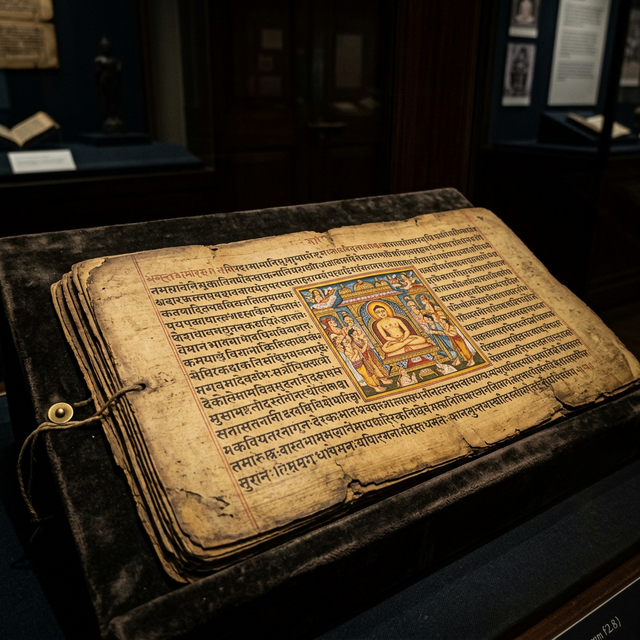
The Buddhist intellectual tradition in India, already severely damaged by the destruction of Nalanda and Vikramashila, received its final blow during the Khilji period. The last surviving centers of Buddhist learning in western and central India were destroyed, ending what had been one of the world's great intellectual traditions on the subcontinent of its birth. The irony that some of this knowledge survived in Tibetan, Chinese, and Southeast Asian translations — while being extinguished in India itself — underscores the magnitude of the cultural catastrophe.[41]
The Compound Effect
Khilji's destruction was not an isolated event. It was compounded by the actions of later invaders, creating layer upon layer of cultural erasure that amplified the original damage exponentially.
The Tughlaq Continuation
The Tughlaq dynasty that succeeded the Khiljis (1320–1413 CE) continued and in some respects intensified the policies of cultural destruction. Muhammad bin Tughlaq's campaigns extended the zone of devastation further south, while Firoz Shah Tughlaq explicitly embraced iconoclasm as state policy. Temples that had survived the Khilji period or been partially rebuilt were targeted anew. The effect was compounding: communities that had begun the painful process of recovery were struck again before they could reconstitute their cultural institutions.[42]
Mughal Period: Selective Continuation
The Mughal period (1526–1857 CE) presents a more complex picture, with significant variation between rulers. While Akbar pursued policies of relative tolerance and even cultural synthesis, Aurangzeb's reign (1658–1707 CE) saw a resurgence of temple destruction and religious persecution that specifically targeted sites that had been rebuilt after the Sultanate-era devastation. The effect was to inflict yet another layer of destruction on cultural heritage that was already severely diminished.[43]
Layer Upon Layer of Erasure
The cumulative effect of successive waves of destruction — from the Ghaznavids through the Delhi Sultanate to the Mughals — was far greater than any single episode. Each wave of destruction built upon the damage of the previous one. A temple destroyed by Khilji's forces and partially rebuilt in the 15th century might be destroyed again by Aurangzeb's forces in the 17th century. The artisan traditions needed to rebuild in the original style, already weakened after Khilji, might be completely extinct by the time Mughal-era destruction occurred.[44]
This compounding effect means that assigning the full measure of damage to any single ruler or period is impossible. What Khilji initiated, the Tughlaqs continued, and later rulers completed. The result was not merely the destruction of individual monuments but the progressive erosion of an entire civilization's material and intellectual heritage over a span of nearly seven centuries. Each successive destruction reduced the remaining cultural capital further, making recovery from the next blow even more difficult.[45]