Temple Destruction &
Cultural Erasure
The systematic destruction of Hindu, Jain, and Buddhist sacred sites — an irreversible cultural genocide documented by contemporary chroniclers.
A Campaign of Annihilation
Under Alauddin Khilji’s direct orders, generals such as Nusrat Khan, Ulugh Khan, and Malik Kafur waged a systematic war against India’s sacred architecture. The numbers, drawn from contemporary chronicles, are staggering.
“The idol was cast down and the fragments of stone, which had been the idol of the Hindus, were carried to Delhi, and the entrance of the Jami Masjid was paved with them so that people might tread upon them.”
— Amir Khusrau, Tarikh-i-Alai (c. 1311), on the fate of Hindu temple idols[1]
The Sack of Somnath Temple
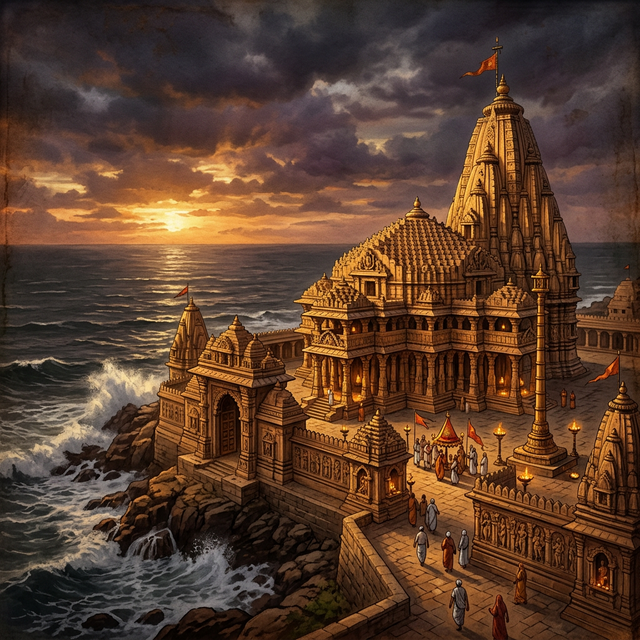
The Somnath temple, one of the most sacred Hindu pilgrimage sites and a revered Jyotirlinga of Lord Shiva, had already endured catastrophic destruction at the hands of Mahmud of Ghazni in 1025 CE.[2] In the intervening centuries, devotees had painstakingly rebuilt the temple, restoring it as a functioning centre of worship and pilgrimage along the coast of Saurashtra.
In 1299 CE, Alauddin Khilji dispatched his generals Ulugh Khan and Nusrat Khan on a massive military expedition to Gujarat. The campaign was one of the largest mounted by the Delhi Sultanate, and the temple of Somnath was a primary target. Upon reaching the temple complex, the Sultanate forces systematically demolished the rebuilt structure, plundered its treasury, and desecrated the sanctum.[3]
The destruction was not merely strategic — it was ideological. The temple’s wealth was seized and sent back to Delhi, while its idols were broken and carried away as trophies. Contemporary chroniclers recorded the event with pride, framing it as a continuation of the legacy begun by Mahmud of Ghazni nearly three centuries earlier.
The Cyclical Tragedy of Somnath
Somnath represents the cyclical nature of temple destruction in medieval India. First destroyed by Mahmud of Ghazni in 1025 CE, it was rebuilt by Hindu devotees only to be destroyed again by Alauddin Khilji’s forces in 1299 CE. This pattern of destruction, rebuilding, and re-destruction would repeat itself across centuries — each cycle erasing layers of irreplaceable art, sculpture, and devotional tradition. The temple was attacked again under later Sultanate rulers, making Somnath a symbol of civilizational resilience as well as unimaginable loss.
“The temple of Somnath was broken and its fragments were carried to Delhi.”
— Ziauddin Barani, Tarikh-i-Firoz Shahi (c. 1357), describing the Gujarat campaign[3]
Temples of Gujarat
The Gujarat campaign of 1299 CE was not limited to Somnath alone. Alauddin’s generals, particularly Nusrat Khan, conducted a sweeping campaign of iconoclasm across the entire region, targeting every major temple complex they encountered on their march through the prosperous province.
Anhilwara (Modern Patan)
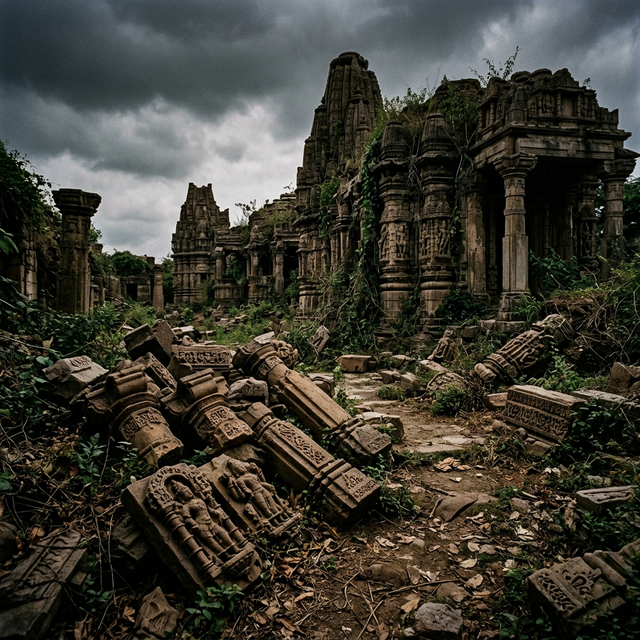
Anhilwara, the ancient capital of the Chaulukya (Solanki) dynasty, was one of the wealthiest and most culturally significant cities in western India. It housed dozens of Hindu and Jain temples, many of them architectural masterpieces built under the patronage of the Solanki rulers over the preceding three centuries. When the Sultanate armies entered Anhilwara, they systematically looted the city’s temples and destroyed or defaced their sculptures and idols.[4] The great Jain temples of Patan — some of the finest examples of western Indian temple architecture — suffered severe damage.
Cambay (Khambhat)
The port city of Cambay (modern Khambhat), a thriving centre of trade and Hindu temple culture along the Gulf of Cambay, was sacked during the same campaign. Its temples were plundered for their wealth, and idols were smashed. Nusrat Khan oversaw the destruction personally, ensuring that no significant Hindu or Jain shrine was left untouched. The wealth extracted from Cambay’s temples was immense, reflecting centuries of devotional offerings by merchants and rulers alike.[3]
Nusrat Khan’s Systematic Iconoclasm
Nusrat Khan’s campaign through Gujarat was characterised by a methodical approach to temple destruction. Rather than random acts of violence, his forces followed a deliberate pattern: first the temple treasury was seized, then the idols were broken and often carried away as trophies, and finally the temple structure itself was either demolished or converted for other purposes. This systematic approach ensured maximum cultural and economic damage while simultaneously enriching the Delhi Sultanate’s coffers.[5]
“The army of Islam swept across Gujarat like a flood, and the temples fell before them as dust before the wind.”
— Amir Khusrau, Khazain-ul-Futuh (c. 1311), on the Gujarat campaign[4]
Temples of Rajputana
Alauddin Khilji’s campaigns through Rajputana — the heartland of Rajput resistance — were among the most brutal of his reign. The great fortress-cities of Ranthambore, Chittor, and Jalor each housed temples of immense religious and architectural significance. After each conquest, the sacred sites within the forts were systematically destroyed.
Ranthambore (1301 CE)
The fortress of Ranthambore, under the Chahamana ruler Hammiradeva, was one of the most formidable in Rajputana. Within its walls stood ancient temples, including shrines to Shiva and Ganesha that had been maintained by the Chahamana dynasty for generations. After an arduous siege that lasted months, the fort fell to Alauddin’s forces. The temples within the fortress complex were desecrated and destroyed. The garrison and population faced mass slaughter; women performed jauhar (self-immolation) rather than face capture.[1]
Chittor (1303 CE)
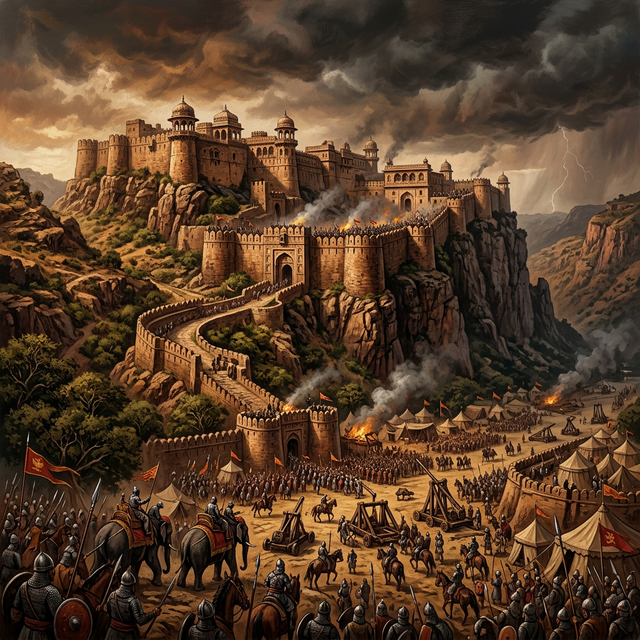
The siege of Chittor in 1303 CE was one of the defining events of Alauddin’s reign. The great Guhila (Sisodia) fortress, perched atop a massive plateau, housed some of the most important temples in Rajputana, including ancient Shiva temples, Jain temples of exquisite craftsmanship, and the revered Kalikamata Temple. After the fort’s fall, Alauddin’s forces conducted a thorough destruction of its sacred sites. The temple treasuries were looted, idols smashed, and many structures razed to the ground.[4]
Amir Khusrau, who accompanied the campaign as court poet, documented the devastation at Chittor. He recorded the demolition of temples with a tone of celebration, noting how idols were pulled down and religious symbols effaced. The cultural loss at Chittor extended beyond architecture — the priests and scholars who maintained the temples were killed or scattered, disrupting centuries-old devotional and intellectual traditions.[4]
Jalor (1311 CE)
The fortress of Jalor, held by the Chahamana ruler Kanhadadeva, fell to Alauddin’s forces after a prolonged siege. The Paramara and Chahamana-era temples within Jalor Fort — including ancient shrines and Jain basadis — were destroyed following the conquest. The Kanhadadeva Prabandha, a later Rajasthani text, preserves accounts of the destruction, describing how the invading army targeted sacred sites with particular ferocity.[6]
Pattern of Post-Conquest Destruction
A consistent pattern emerges across Alauddin’s Rajputana campaigns: after each fortress fell, the temples within were targeted immediately. This was not collateral damage from battle — it was a deliberate policy of cultural erasure carried out after military resistance had ended. The destruction served both ideological and economic purposes, as temple treasuries contained centuries of accumulated wealth in the form of gold, jewels, and precious metals.
Temples of Malwa & Central India
The temple complexes of central India — particularly those in the regions of Malwa, Vidisha, and Dhar — represented some of the finest achievements of Indian sacred architecture. Built under the patronage of the Paramara, Chandela, and other Rajput dynasties, these temples were centres of learning, worship, and artistic excellence for centuries before Alauddin’s armies arrived.
Ujjain
Ujjain, one of the seven sacred cities (Sapta Puri) of Hinduism and the site of the Mahakaleshwar Jyotirlinga, suffered extensively during the Khilji campaigns in Malwa. The city’s ancient temple complexes, which had flourished under Paramara patronage, were targeted by Sultanate forces. The Mahakaleshwar temple, dedicated to Lord Shiva and considered one of the holiest pilgrimage sites in India, was desecrated. Temple wealth accumulated over centuries of royal and public donations was seized and carried back to Delhi.[5]
Bhilsa (Vidisha)
Bhilsa, the ancient Vidisha, was a city of enormous historical and religious significance. It was in this region that some of the earliest Buddhist stupas had been constructed, including the famous Sanchi complex nearby. The Hindu and Jain temples of Vidisha, many dating to the Paramara and earlier periods, were destroyed during the Sultanate incursions into Malwa. The loss extended to Buddhist heritage sites in the surrounding area that had survived for over a millennium.[3]
Dhar
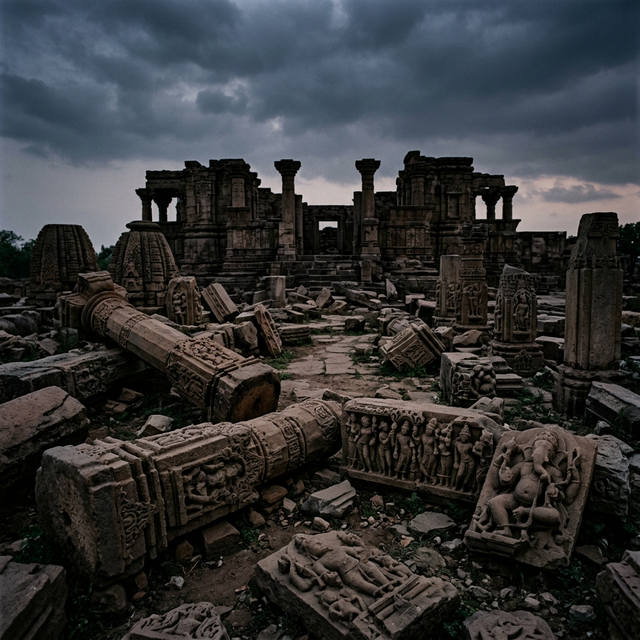
Dhar, the capital of the Paramara dynasty and a renowned centre of Sanskrit learning, was devastated by Alauddin’s forces. The city had been home to the legendary king Bhoja (1010–1055 CE), one of the greatest patrons of learning and temple-building in Indian history. The temples and educational institutions built under Paramara patronage were systematically destroyed. The Bhojshala, believed to have been a centre of learning associated with the goddess Saraswati, was among the structures that suffered during this period. The materials from demolished Hindu temples were later reused in the construction of Islamic structures in the city.[7]
“The temples were demolished and the idols were thrown down. Mosques and places of worship were raised up in their stead.”
— Ziauddin Barani, Tarikh-i-Firoz Shahi (c. 1357), describing the treatment of conquered territories[3]
South Indian Campaigns
The campaigns of Malik Kafur into the Deccan and South India (1306–1311 CE) brought Alauddin Khilji’s campaign of destruction to regions that had never before experienced the might of the Delhi Sultanate. The great temple kingdoms of the Yadavas, Kakatiyas, Hoysalas, and Pandyas — home to some of the most magnificent temple architecture ever created — were subjected to systematic plunder and desecration.
Devagiri (Yadava Kingdom)
Devagiri (modern Daulatabad), the capital of the Yadava dynasty, was first raided by Alauddin himself in 1296 CE, even before he seized the throne of Delhi. This initial raid, which funded his usurpation, involved the plunder of temple treasuries in and around Devagiri. Subsequent campaigns by Malik Kafur in 1307 and 1310 completed the subjugation of the Yadava kingdom and the destruction of its remaining temple complexes. The Yadava temples, built in the distinctive Hemadpanthi style of architecture, were stripped of their wealth and many were damaged or destroyed.[4]
Warangal (Kakatiya Kingdom)
The Kakatiya kingdom, centred at Warangal in the Deccan, was home to some of the most distinctive temple architecture in India. The Kakatiya rulers had patronised the construction of hundreds of temples adorned with their characteristic style of sculpture and intricate carvings. Malik Kafur’s invasion of Warangal in 1309–1310 CE resulted in massive plunder. The famous Swayambhu temple and the great Shiva temples of the Kakatiya capital were looted of their treasures. The Koh-i-Noor diamond is traditionally believed to have been among the jewels seized from the Kakatiya treasury during this campaign.[4]
Dvarasamudra (Hoysala Kingdom)
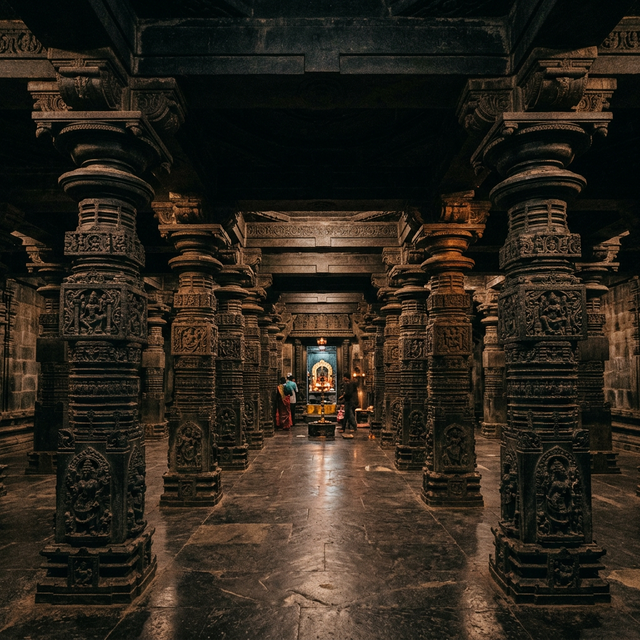
Dvarasamudra (modern Halebidu), the capital of the Hoysala dynasty in present-day Karnataka, was one of the great artistic centres of medieval India. The Hoysala temples — renowned worldwide for their extraordinarily detailed and intricate sculptural programmes — represented the pinnacle of southern Indian temple art. Malik Kafur’s army reached Dvarasamudra in 1311 CE and subjected the city to a thorough sacking. The great Hoysaleswara temple and other sacred complexes were plundered. The Hoysala king Veera Ballala III was forced to submit and pay enormous tribute extracted from temple treasuries.[4]
Madurai (Pandya Kingdom)
Malik Kafur’s campaign reached its southernmost extent at Madurai, capital of the Pandya kingdom in Tamil Nadu, in 1311 CE. The Pandya temples, including structures associated with the great Meenakshi temple complex, were subjected to plunder on an extraordinary scale. Amir Khusrau recorded that the wealth seized from Madurai’s temples was so immense that it had to be carried back to Delhi on hundreds of elephants and thousands of horses. The golden finials, jewelled idols, and accumulated donations of centuries were stripped from the temple complexes.[4]
“The tongue of the sword of the khalifa of the time, which is the tongue of the flame of Islam, has imparted light to the whole darkness of Hindustan by the fire of the sword.”
— Amir Khusrau, Khazain-ul-Futuh (c. 1311), celebrating Malik Kafur’s southern campaigns[4]
The Plunder of Temple Treasuries
The sheer scale of wealth plundered from South Indian temples during Malik Kafur’s campaigns is difficult to comprehend. Contemporary sources describe gold idols weighing hundreds of kilograms, chests overflowing with precious stones, and ornaments accumulated over centuries of royal and devotional patronage. This wealth, transported to Delhi, funded Alauddin’s vast military apparatus and building projects. The temples, stripped bare, lost not only their material wealth but also the economic foundation that sustained their priests, scholars, artists, and the surrounding communities that depended on them.
Libraries & Knowledge Destroyed
The destruction wrought by Alauddin Khilji’s regime extended far beyond stone and mortar. Indian temples were not merely places of worship — they were universities, libraries, and repositories of knowledge. Each major temple complex maintained collections of manuscripts covering philosophy, astronomy, mathematics, medicine, grammar, literature, and the arts. When the temples were destroyed, these irreplaceable intellectual treasures were lost with them.
Centres of Learning Targeted
The great temple-universities of medieval India — mathas, agraharas, and ghatikas — served as the backbone of Indian intellectual life. At Dhar, the educational institutions associated with the Paramara court had preserved and transmitted knowledge in Sanskrit, astronomy, and philosophy for generations. At Anhilwara, Jain scholars had maintained vast libraries of manuscripts covering logic, grammar, and cosmology. Across Rajputana, temple-attached schools taught everything from Vedic ritual to mathematical computation.[5]
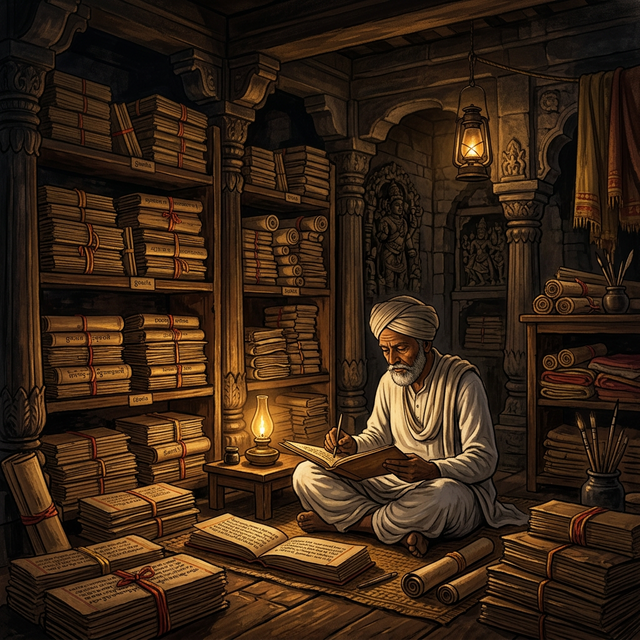
When these centres fell to the Sultanate armies, the fate of their manuscript collections was almost uniformly tragic. Texts written on palm leaf and birch bark — the primary media for Indian manuscripts — were highly vulnerable to deliberate destruction. Unlike stone temples, which sometimes survived in ruined form, burnt manuscripts left no trace. Entire branches of knowledge, philosophical traditions, and literary works vanished without record.[8]
The Scale of Intellectual Loss
The magnitude of intellectual loss is reflected in the gaps that modern scholars encounter when studying medieval Indian history. Entire genres of literature referenced in surviving texts can no longer be found. Scientific treatises cited by later authors have vanished entirely. The works of countless poets, philosophers, mathematicians, and astronomers are known only by name, their actual texts having perished in the conflagrations that consumed India’s temple libraries.[8]
The Jain tradition, which placed particular emphasis on the preservation and copying of manuscripts, suffered especially grievous losses. Jain bhandaras (manuscript repositories) across Gujarat and Rajputana were destroyed during the campaigns. While some Jain communities managed to hide and preserve portions of their collections, vast numbers of texts were lost. The gaps in Jain literary and philosophical traditions from this period bear silent testimony to the scale of destruction.
What Was Lost Can Never Be Counted
Unlike temple architecture, where ruins and fragments allow partial reconstruction, destroyed manuscripts leave no physical evidence of their existence. We know of their loss only through references in other surviving texts, or through gaps in intellectual traditions that cannot otherwise be explained. The true scale of knowledge destroyed during this period will never be known — the absence itself has been erased from history.
Conversion of Sacred Sites
Beyond outright destruction, Alauddin Khilji’s regime practised a systematic policy of converting Hindu and Jain temples into mosques and other Islamic structures. This was not unique to Alauddin — it was a practice inherited from earlier Sultanate rulers — but under his reign, it was carried out on an unprecedented scale across a vastly expanded territory.
The Quwwat-ul-Islam Pattern
The Quwwat-ul-Islam mosque in Delhi, originally constructed by Qutbuddin Aibak in the 1190s using materials from twenty-seven demolished Hindu and Jain temples, established the template that would be followed across the Sultanate’s domains. Alauddin himself expanded this very complex, adding the famous Alai Darwaza gateway (completed 1311 CE) and beginning construction of an enormous new minaret intended to dwarf the Qutb Minar. The expansion utilised additional temple materials, incorporating intricately carved Hindu pillars, lintels, and ceiling panels into the mosque complex.[9]
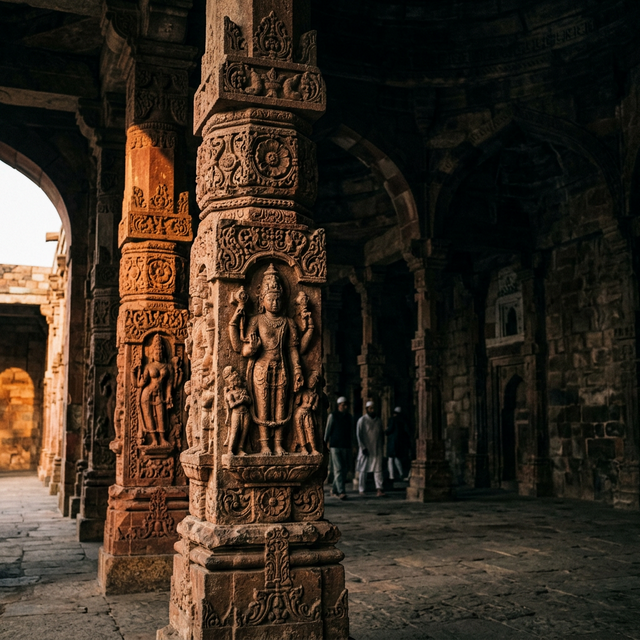
This pattern — demolishing a temple and using its materials to construct a mosque on the same site or nearby — was replicated across India during Alauddin’s reign. The practice served multiple purposes: it provided readily available, finely carved building materials; it symbolically demonstrated the supremacy of the new order over the old; and it prevented the Hindu population from reclaiming and restoring their sacred sites.[7]
Reuse of Temple Materials
Archaeological evidence across India reveals the extensive reuse of temple materials in Sultanate-era constructions. Intricately carved pillars with Hindu deities can be found incorporated into mosque walls, often placed upside down or with the carved faces turned inward as a deliberate act of humiliation. Temple doorframes, ceiling panels, and decorative elements were repurposed throughout the territories conquered by Alauddin’s forces. At Dhar, Vidisha, and across Gujarat and Rajputana, the physical remnants of Hindu temples can be traced in the foundations and walls of later Islamic structures.[9]
“He built mosques on the sites where temples had stood, and the call to prayer was raised where once the bells of idol-worship had sounded.”
— Ziauddin Barani, Tarikh-i-Firoz Shahi (c. 1357)[3]
The Irreversible Loss
The destruction of temples during Alauddin Khilji’s reign represents a wound in the fabric of Indian civilisation that can never fully heal. What was lost extends far beyond stone structures and golden idols — it encompasses entire artistic traditions, chains of knowledge transmission, devotional practices, and the intangible cultural heritage of communities that had maintained these sites for centuries.
Artistic Traditions Severed
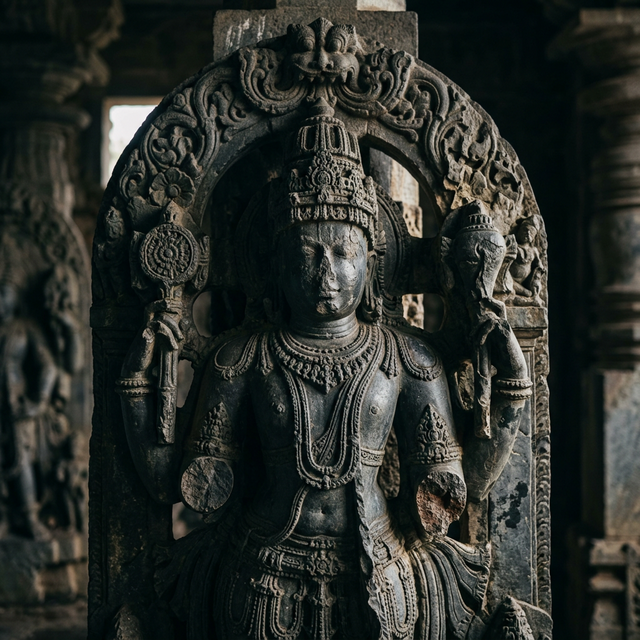
Indian temple sculpture and architecture were not produced by anonymous craftsmen working in isolation. They were the products of highly organised guilds (shilpi-shalas) that transmitted their skills through generations of master-apprentice relationships. Each region developed distinctive sculptural styles — the sensuous forms of Hoysala carving, the geometric precision of Chalukyan architecture, the ornate elaboration of Solanki Gujarat temples. When the temples were destroyed and the patronage systems that sustained them collapsed, these living artistic traditions were disrupted. Some recovered in altered forms; others were lost entirely.[10]
Sculptural Traditions Broken
The destruction of temples also meant the destruction of the contexts in which sculptural traditions were maintained and passed on. Temple construction was the primary engine of sculptural production in medieval India. Without ongoing patronage for temple building, the demand for trained sculptors diminished, and the knowledge chains that sustained their craft were broken. The sharp decline in the quality and quantity of temple sculpture in regions affected by Sultanate conquests is a measurable consequence of this disruption.[10]
Temple Architecture Knowledge Disrupted
Indian temple architecture was governed by a sophisticated body of theoretical knowledge codified in texts known as Vastu Shastras and Shilpa Shastras. These texts, combined with practical knowledge transmitted within architect guilds, enabled the construction of increasingly complex and ambitious temple structures. The destruction of temples, the killing or dispersal of master architects, and the loss of architectural manuscripts together dealt a devastating blow to this tradition. While temple construction continued in regions that remained independent, the pan-Indian tradition of monumental temple architecture suffered a permanent setback from which it never fully recovered.[8]
Communities Uprooted
Each temple was the centre of a community. Priests, musicians, dancers, scholars, artisans, and the devotees who supported them all depended on the temple as the focal point of their social, economic, and spiritual lives. When a temple was destroyed, it was not merely a building that was lost — it was the entire ecosystem of cultural production and community life that it sustained. Entire hereditary traditions of temple music, ritual dance (devadasi traditions), and devotional poetry were disrupted. Some of these traditions survived by migrating to courts or private patronage; many more vanished without trace.
What Can Never Be Recovered
A temple can be rebuilt — Somnath itself has been reconstructed in the modern era. But the original sculptures, crafted by hands that carried the knowledge of generations, can never be replicated. The manuscripts that burned can never be rewritten. The musical and dance traditions that died with their practitioners can never be revived. The philosophical debates that took place in temple halls can never be reconstructed. What Alauddin Khilji’s campaigns destroyed was not merely physical infrastructure — it was the living cultural memory of a civilisation.
“The loss of Hindu temples during the Sultanate period represents not merely the destruction of buildings, but the disruption of an entire civilisational pattern in which the temple was the central institution of social, cultural, and intellectual life.”
— George Michell, The Hindu Temple: An Introduction to Its Meaning and Forms (1977)[10]