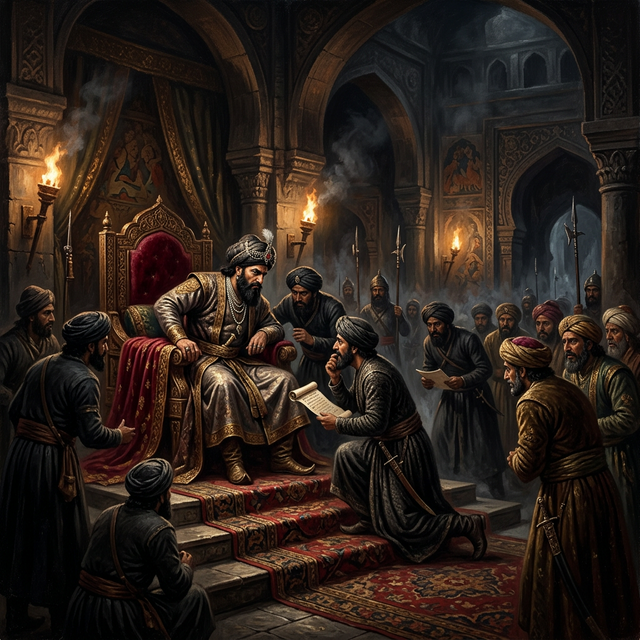
Rise to Power
From provincial governor to Sultan of Delhi — a treacherous path paved with betrayal, plunder, and the blood of his own kin.
Origins — Ali Gurshasp
The man who would become one of medieval India's most ruthless rulers was born Ali Gurshasp, likely around 1266–1267 CE, into the Khalji (also spelled Khilji) tribe of Turkic-Afghan origin. The Khaljis had settled in Afghanistan for generations before migrating to India, and while they claimed Turkish heritage, they were often regarded by the ruling Turkish elite of Delhi as being of mixed or lesser lineage. This sense of being outsiders within the ruling class would shape the ambitions and insecurities of the Khalji clan throughout their ascent.
Ali Gurshasp's fortunes were tied inextricably to his uncle, Jalaluddin Firuz Khalji, a veteran military commander who had served the later Mamluk (Slave) dynasty sultans. Jalaluddin was an aging noble known for his relatively mild temperament, a trait that would ultimately prove his undoing. When the declining Mamluk sultan Qaiqabad fell into incapacity and disorder consumed Delhi in 1290, Jalaluddin Khalji seized the throne, founding the Khalji dynasty and becoming Sultan Jalaluddin Khalji.
Ali Gurshasp was not merely Jalaluddin's nephew — the connection ran deeper. He was married to Jalaluddin's daughter, Malika-i-Jahan, making him both nephew and son-in-law to the Sultan. This dual bond placed him firmly within the inner circle of the new ruling family. Jalaluddin, recognizing his nephew's abilities (if not yet fully grasping his ambitions), appointed Ali Gurshasp to the key position of governor of Kara, a strategic province in the Awadh region (modern-day Uttar Pradesh), and later added the governorship of Manikpur (in the Allahabad region) to his responsibilities.
The Khalji dynasty's rise was itself built on usurpation. Jalaluddin Khalji overthrew the infant Mamluk Sultan Kayumars in 1290. The Khaljis were considered outsiders by the established Turkic nobility of Delhi — a fact that made the early Khalji period one of constant political insecurity and the need to prove legitimacy through displays of military strength.
As governor of Kara, Ali Gurshasp displayed the qualities that would define his later reign: ruthless efficiency, strategic cunning, and limitless ambition. He began building his own loyal base of followers, commanders, and soldiers independent of the Sultan's court. He kept his province's revenue accounts deliberately opaque, funneling surplus wealth into his personal treasury rather than forwarding it to Delhi. He cultivated relationships with disaffected nobles and ambitious officers who chafed under Jalaluddin's lenient rule.
The historian Ziauddin Barani, whose Tarikh-i-Firoz Shahi remains the most detailed primary source for this period, portrays the young governor as a man consumed by ambition from the very start — a schemer who viewed his uncle's throne not as a family legacy to be respected, but as a prize to be seized.
"Ali Gurshasp harboured in his heart designs upon the throne. He was ever seeking means to carry out his ambitions, and spared no effort in gathering wealth and winning the hearts of soldiers."
— Ziauddin Barani, Tarikh-i-Firoz Shahi[1]
What made Ali Gurshasp particularly dangerous was his understanding that in the political environment of the Delhi Sultanate, power ultimately rested not on dynastic right or religious sanction, but on military force and gold. He needed both in enormous quantities, and the governorship of Kara, while useful, could not provide wealth on the scale he required. His eyes turned south, to the fabled riches of the Deccan kingdoms — realms that had never been plundered by a Delhi army.
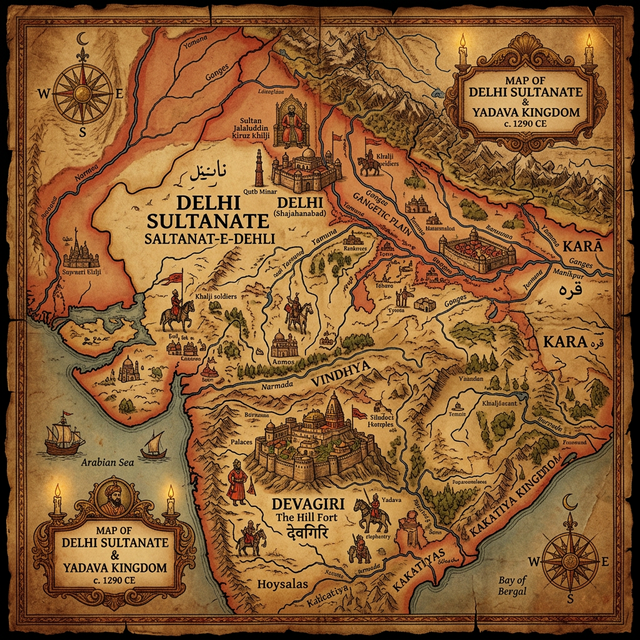
The Devagiri Raid (1296 CE)
In 1296 CE, Ali Gurshasp undertook what was arguably the most audacious military gamble of the thirteenth century in India — an unauthorized invasion of the Yadava kingdom of Devagiri (modern Daulatabad, Maharashtra), conducted entirely without the knowledge or permission of Sultan Jalaluddin. This was not merely a border raid; it was a calculated, deep-penetration assault covering over a thousand kilometers into territory that no Delhi army had ever reached, through uncharted and hostile terrain.
Strategic Calculation
Ali Gurshasp's target was carefully chosen. The Yadava dynasty, ruled at that time by King Ramachandra (also known as Ramadeva), presided over one of the wealthiest kingdoms in the Deccan. Devagiri was a major center of trade, controlling key routes between northern and southern India. The Yadava treasury was legendary, swollen with revenues from fertile agricultural lands, trade in textiles and horses, and tribute from subordinate chiefs. Most critically, the kingdom had never been subjected to the kind of devastating plunder-raids that had become routine in northern India under successive Sultanate rulers.
Ali Gurshasp gathered detailed intelligence about Devagiri through merchants, spies, and possibly defectors. He learned that King Ramachandra's main army, under his son Singhana, was away campaigning in the south against the Hoysala kingdom. The timing was perfect.
The March South
To maintain secrecy, Ali Gurshasp told Sultan Jalaluddin that he intended to raid Bhilsa (modern Vidisha in Madhya Pradesh), a much closer and less significant target. He set out from Kara with a force of approximately 8,000 cavalry — a relatively small but highly mobile army. He divided his force, sending one contingent toward Bhilsa as a feint and leading the main body on a rapid forced march southward through the Vindhya ranges and into the Deccan.
The march itself was a remarkable feat of logistics and determination. The army covered treacherous terrain through dense forests, crossed rivers, and navigated mountain passes, all while maintaining operational secrecy. The people of Devagiri had no warning until the invaders were practically at their gates.
Ali Gurshasp's 1296 raid on Devagiri was the first time a Delhi Sultanate army penetrated the Deccan plateau. The roughly 1,000-kilometer march from Kara to Devagiri through uncharted territory, with only 8,000 mounted troops, was a logistical feat driven entirely by the lust for plunder rather than any strategic or religious mandate from the Sultan.
The Fall of Devagiri
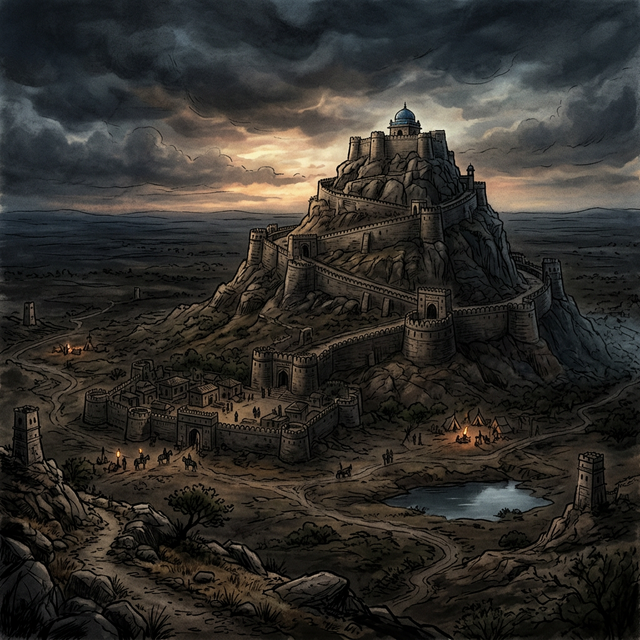
The attack on Devagiri caught King Ramachandra completely off guard. The Yadava capital, while fortified with a formidable hill-fort, was undermanned with the main army absent. Ramachandra attempted to resist but was quickly overwhelmed. After initial skirmishes, the Yadava king retreated into the citadel fort atop the Devagiri hill.
According to Barani and other chroniclers, Ramachandra sued for peace when he realized the hopelessness of his situation. The terms Ali Gurshasp imposed were devastating:
- 600 maunds of gold (roughly 14,400 kilograms or over 31,000 pounds)
- 1,000 maunds of silver
- Vast quantities of pearls, precious gems, and silk textiles
- Elephants, horses, and other war materiel
When Singhana returned with the Yadava army and attempted a counterattack, Ali Gurshasp defeated him as well, extracting even more tribute as the price of withdrawal. The total plunder was staggering — the chronicler Amir Khusrau, the court poet who would later glorify Alauddin's reign, described the wealth in terms that suggest it exceeded anything previously brought to Delhi.
"He obtained such an immense amount of gold that it is beyond all bounds of reckoning. Never had so vast a treasure been brought to Delhi by any conqueror. The wealth of Devagiri exceeded the wildest imaginings of men."
— Amir Khusrau, Khazain-ul-Futuh[2]
The Purpose of the Plunder
Ali Gurshasp had no intention of handing this stupendous wealth over to Sultan Jalaluddin. The entire Devagiri operation had been designed from the start as the financial foundation for a coup. With this treasure, he could buy the loyalty of every ambitious noble, commander, and soldier in the Sultanate. He had transformed himself overnight from a provincial governor into the richest and most dangerous man in India — richer, in liquid wealth, than the Sultan himself.
When news of the Devagiri plunder reached Delhi, it caused a sensation. Jalaluddin, rather than being alarmed at his nephew's unsanctioned military adventure, was reportedly delighted at the prospect of receiving a share of the treasure. This naive enthusiasm would lure the old Sultan to his death.
The Murder of Sultan Jalaluddin
The assassination of Sultan Jalaluddin Firuz Khalji by his nephew Ali Gurshasp in 1296 CE stands as one of the most chilling episodes of treachery in Indian history. The event is documented in extraordinary detail by the contemporary historian Ziauddin Barani in his Tarikh-i-Firoz Shahi, providing a near eyewitness-level account of how ambition devoured familial bonds and loyalty.
The Lure
After returning to Kara from Devagiri with his mountain of plunder, Ali Gurshasp initiated a carefully orchestrated campaign of deception. He sent word to Sultan Jalaluddin in Delhi that he wished to present the vast Devagiri treasure to the Sultan in person, framing the entire expedition as having been conducted in the Sultan's name and for the Sultan's glory. He expressed concern that enemies at court might intercept or misrepresent the tribute if it were sent through intermediaries, and he pleaded for the Sultan to come to Kara personally to receive the wealth.
Some of Jalaluddin's advisors urged caution. Ahmad Chap, a senior noble, reportedly warned the Sultan that Ali Gurshasp's behavior was suspicious — that a loyal governor would bring the treasure to Delhi, not summon the Sultan to the provinces. But Jalaluddin, motivated by a combination of greed for the Devagiri gold and what Barani characterizes as a genuine fatherly affection for his nephew-son-in-law, dismissed these warnings.
"The Sultan's courtiers cautioned him against going to Kara, saying that the conduct of Ali was suspicious. But the Sultan replied: 'Ali is like a son to me. He has conquered Devagiri and won glory for my throne. I will go to him, and he shall place the spoils of the Deccan at my feet.'"
— Ziauddin Barani, Tarikh-i-Firoz Shahi[1]
Jalaluddin set out from Delhi toward Kara with a modest entourage, fatefully leaving behind the bulk of his army and bodyguard. As he approached, Ali Gurshasp sent further messages of humble devotion, reinforcing the image of a loyal nephew eager to honor his sovereign.
The Trap at Kara
Ali Gurshasp had planned the assassination meticulously. He stationed his most trusted and ruthless followers at strategic points, briefing them on their roles in advance. Among the key conspirators were:
- Alp Khan — a trusted commander
- Muhammad Salim — later known as Ikhtiyaruddin, a fierce loyalist
- Nusrat Khan — who would become one of Alauddin's chief generals
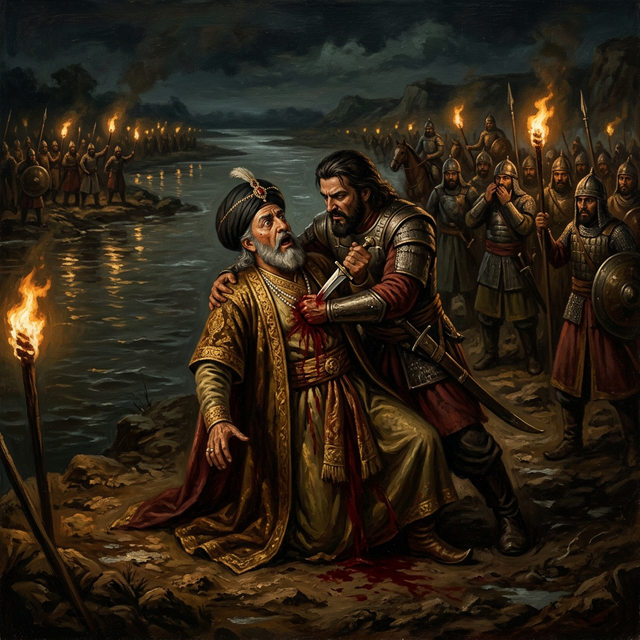
When Jalaluddin arrived at the banks of the Ganga near Kara, Ali Gurshasp came out to receive him. Barani's account of this moment is devastating in its detail. Ali Gurshasp approached the Sultan with every outward sign of submission and affection. He prostrated himself, wept, and embraced his uncle's feet — all while his assassins lurked nearby, waiting for the agreed signal.
The Assassination
The fateful moment came when Ali Gurshasp embraced Sultan Jalaluddin. According to Barani's detailed account, as Ali Gurshasp clasped the old Sultan, he gave the predetermined signal. Muhammad Salim struck first, slashing at the Sultan with a sword. The blow cut into Jalaluddin, who reportedly cried out in shock and anguish:
"The Sultan cried: 'Thou wretch, Ali! What hast thou done?' But Ali gave a signal and Muhammad Salim struck the Sultan with a sword. The attendants of the Sultan turned to flee. The old king staggered toward the river bank, his blood pouring upon the earth, and there he fell."
— Ziauddin Barani, Tarikh-i-Firoz Shahi[1]
The wounded Sultan attempted to flee toward the river, but he was pursued and cut down by multiple assailants. His head was severed and paraded on a spear — a grim trophy of Ali Gurshasp's successful coup. The few attendants who had accompanied Jalaluddin were either killed or fled in terror. It was July 19, 1296 CE.
The murder of Jalaluddin was extraordinary even by the violent standards of Sultanate politics. This was not a battlefield death or a palace coup by strangers — it was the premeditated murder of a reigning Sultan by his own nephew and son-in-law, carried out through the deliberate abuse of familial trust. Barani uses this episode as a moral lesson on the dangers of misplaced trust and unchecked ambition throughout his chronicle.
The killing sent shockwaves through the Sultanate. Jalaluddin, for all his political limitations, had been regarded as a relatively just and moderate ruler. His murder by a close family member under the guise of a family reunion established a pattern of ruthless treachery that would characterize the entire Khalji period. It demonstrated to every noble in the realm that Ali Gurshasp — soon to style himself Sultan Alauddin — would stop at absolutely nothing to achieve and hold power.
Seizing the Throne
With Jalaluddin dead and his severed head displayed as proof, Ali Gurshasp moved swiftly and deliberately to consolidate his seizure of power. The transformation from provincial governor to Sultan required not just the removal of the old ruler, but the wholesale purchase of an empire's loyalty — and the Devagiri treasure provided exactly the currency needed.
Buying the Nobility
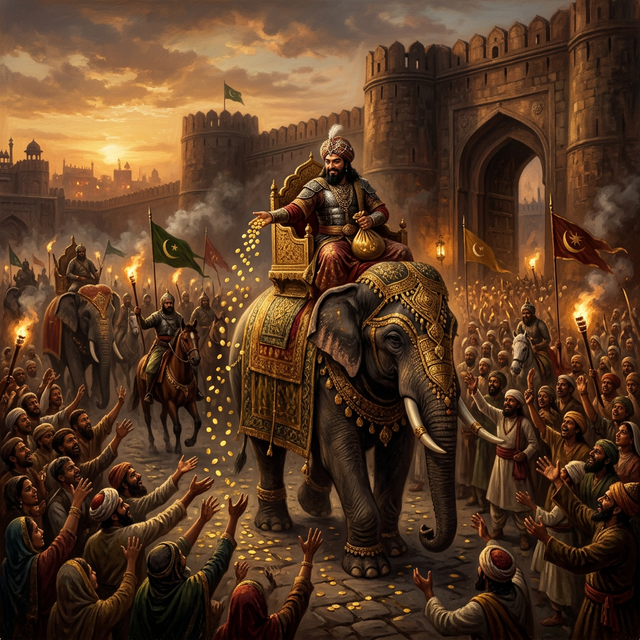
Immediately after the assassination, Ali Gurshasp opened the vast Devagiri treasure and began distributing it with calculated generosity. The sums dispersed were unprecedented in the history of the Delhi Sultanate:
- Senior amirs and nobles received lavish grants of gold, horses, and land assignments
- Military commanders were given enormous bonuses to transfer their loyalty
- Common soldiers received generous cash payments far exceeding normal stipends
- Religious scholars and Sufi figures received endowments to lend spiritual legitimacy
- Merchants and traders received patronage and commercial privileges
Barani describes how Ali Gurshasp literally threw gold at the problem of legitimacy. He writes that the usurper distributed wealth so freely that the nobles and soldiers who might otherwise have rallied to avenge Jalaluddin were instead falling over themselves to swear allegiance to the new power.
"He scattered gold with both hands, and the nobles, seeing the wealth of Devagiri poured out before them like rain, forgot their loyalty to the dead Sultan. Greed sealed their mouths; gold purchased their swords. Those who had served Jalaluddin faithfully now rushed to prostrate before his murderer."
— Ziauddin Barani, Tarikh-i-Firoz Shahi[1]
The March to Delhi
With a growing army of newly-purchased loyalists at his back, Ali Gurshasp began his march from Kara to Delhi. Along the route, he continued his strategy of lavish bribery, winning over garrison commanders and local governors who controlled the fortified towns between Kara and the capital. At each stop, his army grew larger as soldiers deserted Jalaluddin's remaining loyalists and joined the side that was both winning and paying.
The remnants of Jalaluddin's court, now led by his sons Ruknuddin Ibrahim and Qadr Khan and the widow empress Malika-i-Jahan (the elder, not Alauddin's wife), attempted to organize resistance. But the dead Sultan's family found the ground crumbling beneath them. Nobles who had sworn oaths of loyalty were quietly slipping away to join Ali Gurshasp. The treasury in Delhi was far leaner than the rivers of Devagiri gold the usurper was dispensing.
Coronation as Sultan Alauddin
Ali Gurshasp entered Delhi in triumph. On October 3, 1296 CE, he formally ascended the throne, taking the regal title Sultan Alauddin and adopting the honorific Sikandar-i-Sani (the Second Alexander), signaling his grandiose self-image as a world conqueror. The khutba (Friday sermon) was read in his name in the mosques of Delhi, and coins were struck bearing his title — the two essential markers of sovereign legitimacy in the Islamic political tradition of the period.
Amir Khusrau, who would become Alauddin's chief panegyrist, composed elaborate verses celebrating the new Sultan's accession, carefully reframing the bloody usurpation as a divinely ordained transfer of power.
"The new Sultan showered gold upon Delhi like the clouds shower rain upon the earth. Such was his generosity at his accession that men forgot all that had passed before. The treasures of the south had been ordained by fate to adorn the throne of Delhi."
— Amir Khusrau, Khazain-ul-Futuh[2]
Alauddin's seizure of power offers a stark illustration of how the Delhi Sultanate functioned. Dynastic legitimacy, religious sanction, and legal right all mattered far less than raw military force backed by sufficient gold. Alauddin had murdered a reigning Sultan — his own uncle and father-in-law — and yet secured the throne within months, simply because he could pay for it. This precedent would haunt the Sultanate for decades.
Consolidation of Power
Securing the throne was only the beginning. Alauddin understood that a power built on betrayal and bribery remained inherently fragile. The years immediately following his accession — roughly 1296 to 1300 CE — were devoted to a systematic and merciless consolidation that transformed him from a successful usurper into an autocrat of near-absolute power.
Elimination of Jalaluddin's Family
Alauddin moved methodically against the surviving members of Jalaluddin's immediate family, viewing them as the most dangerous focal points for any counter-revolution:
- Ruknuddin Ibrahim, Jalaluddin's eldest son, attempted to hold Multan with a small force. Alauddin's generals pursued and defeated him. Ruknuddin was captured and blinded — a common Sultanate method of politically neutralizing rivals while avoiding the appearance of outright regicide.
- Qadr Khan (Arkali Khan), another of Jalaluddin's sons who had been governor of Multan, was also hunted down. He was captured, blinded, and imprisoned along with his brother.
- Malika-i-Jahan (the elder), Jalaluddin's chief widow, and other women of the former Sultan's household were stripped of their wealth and reduced to destitution. Barani records that they were subjected to humiliating imprisonment.
- Numerous lesser relatives, courtiers, and supporters of the old regime were executed, imprisoned, or driven into exile.
"The sons of Jalaluddin were blinded and cast into prison. Their women were left without sustenance. The supporters of the old house were scattered like leaves before a storm. Alauddin spared none who might one day raise a banner against him."
— Ziauddin Barani, Tarikh-i-Firoz Shahi[1]
Purging Potential Threats
Alauddin's paranoia extended far beyond Jalaluddin's immediate family. In the early years of his reign, he faced several conspiracies and revolts — both real and imagined — that reinforced his conviction that only total, fear-based control could keep him in power.
In 1299–1300 CE, a series of noble revolts shook the Sultanate. The most serious were the rebellions of Haji Maula in Delhi itself and the Mongol-sympathizing nobles who plotted to overthrow Alauddin in favor of a Mongol alliance. Alauddin crushed each revolt with extreme savagery. After the suppression of these conspiracies, he ordered mass executions of suspected plotters and their families. Barani describes entire households — including women and children — being put to the sword on the mere suspicion of disloyalty.
These experiences crystallized Alauddin's governing philosophy into four explicit principles, which Barani records him articulating directly:
- Eliminate all wealth among the nobility that could fund rebellion — impoverishing potential rivals through confiscatory taxation and seizure of estates.
- Establish an all-pervasive intelligence network — the barid system of spies and informers embedded in every level of society.
- Ban alcohol and social gatherings among the nobles — preventing the kind of private assemblies where conspiracies could be hatched.
- Prevent intermarriage and alliances among noble families — blocking the formation of power blocs that could challenge the Sultan.
The Barid System — Alauddin's Intelligence Network
Perhaps the most feared instrument of Alauddin's consolidation was his elaborate espionage apparatus. The barid (intelligence) system was not entirely new — previous Sultans had employed spies — but Alauddin expanded it into a vast, multi-layered surveillance state unprecedented in Indian history to that point.
The system operated at multiple levels:
- Barids (intelligence officers) were posted in every province, city, and military camp, reporting directly to the Sultan through secure channels independent of the normal administrative hierarchy.
- Munhiyan (secret informers) were embedded among the nobility, in bazaars, in religious gatherings, and even within private households of senior nobles. These were often people of low social status whose presence would not arouse suspicion.
- Cross-checking systems ensured that no single intelligence source could deceive the Sultan. Multiple independent spies monitored the same targets, and their reports were compared for consistency.
- The system extended to monitoring the Sultan's own household and harem, creating an atmosphere of pervasive mutual suspicion.
"So effective was the intelligence system of Alauddin that no noble dared to hold a private assembly or feast without the knowledge of the Sultan. Even within the walls of their own homes, men spoke in whispers, for they knew not whether the servant pouring their wine might be the Sultan's eyes and ears."
— Ziauddin Barani, Tarikh-i-Firoz Shahi[1]
Barani records that under Alauddin's intelligence system, nobles became so terrified that they ceased all social interaction beyond the bare minimum required by official duty. Private feasts, marriages between noble families, and even casual visits between households required the Sultan's prior approval. The penalty for unauthorized gatherings could be imprisonment, blinding, or death. Delhi's ruling elite lived in a state of perpetual fear that defined the character of the entire Khalji period.
Alauddin's Own Assessment
Barani provides a remarkable passage in which Alauddin himself reflects on the methods he used to secure his power, speaking to his advisor Qazi Mughis:
"I am an unlettered man, but I have seen a great deal. I have found that the Hindus will never become submissive and obedient until they are reduced to poverty. I have therefore given orders that just sufficient shall be left to them of corn and milk and curds from year to year, but that they shall not be allowed to accumulate property or wealth."
— Alauddin Khilji, as recorded by Ziauddin Barani, Tarikh-i-Firoz Shahi[1]
This statement — one of the most frequently cited passages in medieval Indian historiography — reveals the dual nature of Alauddin's consolidation strategy. His policies of impoverishment and surveillance were directed not only at the Muslim nobility who might challenge his throne, but equally (and perhaps more severely) at the Hindu population, whose subjugation he regarded as essential to the stability of Sultanate rule. The economic oppression that would define his reign was already being articulated as state policy during these early years of consolidation.
By approximately 1300 CE, Alauddin had transformed himself from a usurper clinging to a stolen throne into the most powerful and feared ruler the Delhi Sultanate had yet produced. The mechanisms of terror and control he established during these consolidation years would remain in place throughout his reign, enabling the devastating military campaigns and exploitative economic policies that followed.